رده بندی / نامها
اسامي عام | مترادف | Catalog of Fishes(جنس, گونه ها) | ITIS | CoL | WoRMS | Cloffa
>
Gadiformes (Cods) >
Macrouridae (Grenadiers or rattails)
Etymology: Coelorinchus: Greek, koilos = a hollow + Greek, rhyngchos = jaw (Ref. 45335).
More on author: Risso.
Taxonomic Remarks
Eschmeyer and Bailey in Eschmeyer (1990:70) changed the spelling of the name from Coelorinchus coelorhincus (or Coelorhynchus coelorhynchus) to Caelorinchus caelorhincus, based on their interpretation of the name; caelo (an awl or engraving tool) made more sense than coelo (hollow). Iwamoto had followed their spelling since that time. However, Dr. Dirk Nolf (Institut royal des Sciences naturelles de Belgique) has informed him (in litt., 8 April 2003) that the name should be spelled with the dipthong oe based on the following logic: Giorna’s paper is in French, a language that does not have the dipthong 'ae'. Giorna (1810:179) writes: "Le Coelorinque-Coelorinchus, the first two words being French, the last Latin. The dipthong 'oe', logically must be the same in the two. Since the first name is in French, the second can only be spelled with an 'oe'. Nevertheless, revisiting the issue, Iwamoto, Eschmeyer and Fricke showed that the species should be written 'cae' (May 2008, email exhchanges).
محیط زیست: محیط زیست / منطقه آب و هوایی / تغييرات عمق / محدوده توزیع
بوم شناسي
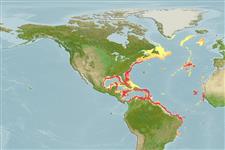
دريايي موجوداتی که در محدوده وسیعی از آبهای آزاد از نزدیک بستر و یا روی کف بستر، در قسمت های میان آبی تا سطح آب و در برخی گونه ها با قابلیت پرواز، زندگی و تغذیه می کنند.; غير مهاجر; تغييرات عمق 90 - 1485 m (Ref. 104125), usually 200 - 500 m (Ref. 1371). Deep-water; 62°N - 18°S, 98°W - 17°W (Ref. 1371)
Northeast Atlantic and Mediterranean Sea. A loose sort of southern limit for Caelorinchus caelorhincus caelorhincus is probably around Cape Verde; most specimens south and to the east into the Gulf of Guinea are likely to be Caelorinchus caelorhincus geronimoi (Iwamoto 1997, pers. Comm.). Northwest Atlantic: Canada (Ref. 5951).
اندازه / وزن / سن
بلوغ: Lm ? range ? - ? cm
Max length : 48.0 cm TL جنس نر / بدون خواص جنسي; (Ref. 5951); common length : 30.0 cm TL جنس نر / بدون خواص جنسي; (Ref. 2683); بيشينه سن گزارش شده: 10 سال ها (Ref. 58045)
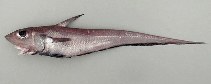
خارهاي باله پشتي (کل) : 0; خارهاي باله مخرجي: 0. Eyes large; snout short, moderately pointed, its anterolateral margin incompletely supported by bone. Head ridges strong but with rather fine spinules; terminal snout scute trifid, wider than long, small and blunt to large and pointed, with a terminal and two lateral arms of about equal size. Underside of the snout naked medially. Light organ large, a black naked fossa between and slightly anterior to the pelvic fin bases. Overall color is pale grayish-brown to swarthy, with a series of broad saddle marks in some; oral cavity pale to dark (Ref. 1371). Spiny fin ray of first dorsal fin with a smooth and rounded leading edge (Ref. 35388).
Body shape (shape guide): elongated; Cross section: circular.
Found commonly in about 200-500 m. Feeds on a variety of benthic organisms, such as polychaetes, gastropods, cephalopods, numerous crustacean groups (copepods, gammarians, isopods, cumaceans, Natantia) and fish. Minimum depth range taken from Ref. 1371.
چرخه زندگی و رفتار جفتگیری
بلوغ | تولید مثل | تخم ریزی | تخم ها | باروری | توزاد ( لارو)
Cohen, D.M., T. Inada, T. Iwamoto and N. Scialabba, 1990. FAO species catalogue. Vol. 10. Gadiform fishes of the world (Order Gadiformes). An annotated and illustrated catalogue of cods, hakes, grenadiers and other gadiform fishes known to date. FAO Fish. Synop. 125(10). Rome: FAO. 442 p. (Ref. 1371)
وضعيت در فهرست قرمز IUCN (Ref. 130435: Version 2025-2 (Global))
خطر برای انسان ها
Harmless
استفاده انسانی
ماهي گيري – شيلات: ارزش تحاري اندك
ابزارها
گزارش های ويژه
بارگيری XML
منابع اينترنتي
تخمینها بر اساس مدلها
دمای ترجیحی (مرجع
123201): 8.6 - 19.6, mean 13.2 °C (based on 160 cells).
شاخص تنوع فیلوژنتیکی (مرجع
82804): PD
50 = 0.5000 [Uniqueness, from 0.5 = low to 2.0 = high].
Bayesian length-weight: a=0.00195 (0.00162 - 0.00234), b=3.15 (3.10 - 3.20), in cm total length, based on LWR estimates for this species (Ref.
93245).
سطح تروفیک (مرجع
69278): 3.5 ±0.2 se; based on diet studies.
جهندگی (مرجع
120179): پايين ، كم, كمينه زمان لازم براي دو برابر شدن جمعيت 5/4 – 14 سال (K=0.13-0.15; tmax=8).
آسیبپذیری ماهیگیری (Ref.
59153): Moderate vulnerability (38 of 100).
🛈
مواد مغذی (Ref.
124155): Calcium = 16.7 [8.0, 38.2] mg/100g; Iron = 0.302 [0.148, 0.621] mg/100g; Protein = 15.4 [13.3, 17.9] %; Omega3 = 0.222 [0.093, 0.498] g/100g; Selenium = 25.6 [9.1, 65.5] μg/100g; VitaminA = 17.1 [3.3, 84.4] μg/100g; Zinc = 0.495 [0.309, 0.805] mg/100g (wet weight);