Environnement : milieu / zone climatique / profondeur / gamme de distribution
Écologie
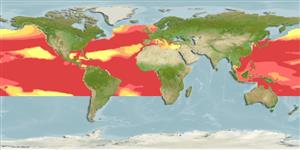
marin pelagic-oceanic; océanodrome (Ref. 51243); profondeur 0 - 200 m (Ref. 6517). Subtropical; 60°N - 25°S, 180°W - 180°E
Atlantic, Indian and Pacific: in temperate and tropical waters (Ref. 47377). Western Atlantic: USA and eastern Gulf of Mexico (Ref. 7251). Eastern Atlantic: Bergen, Norway to Madeira and near the Azores, including western Mediterranean; west of Cape Point, South Africa (Ref. 6657). Western Pacific: Japan, Australia, and New Zealand (Ref. 5755). Eastern Pacific: Oregon, USA to Chile (Ref. 2850).
Taille / Poids / Âge
Maturité: Lm ? range ? - ? cm
Max length : 200 cm TL mâle / non sexé; (Ref. 9314); common length : 152 cm SL mâle / non sexé; (Ref. 6517); poids max. publié: 150.0 kg (Ref. 47377)
Description synthétique
Clés d'identification | Morphologie | Morphométrie
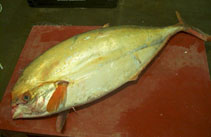
Rayons mous dorsaux (Total) : 20; Épines anales: 0; Rayons mous anaux: 18; Vertèbres: 22. Absence of dorsal and anal spines and of pelvic fins contribute to streamlining of the body, as does the flat and relatively consolidated opercular spines (Ref. 11017, p. 74).
Body shape (shape guide): fusiform / normal; Cross section: compressed.
Oceanic and epipelagic; found near surface or in deep water (Ref. 10821). Apparently solitary (Ref. 9314). Feed mainly on jellyfishes, ctenophores, and other gelatinous planktonic animals (Ref. 2850, 6885). Spawning starts at the end of spring and during the summer (Ref. 9314). Juveniles unlike adults in that the median fins are longer and further forward, the mouth toothed and the body and fins black-spotted (Ref. 6517). Rarely found in markets (Ref. 9314).
Cycle de vie et comportement reproducteur
Maturité | Reproduction | Frai | Œufs | Fécondité | Larves
Tyler, J.C., G.D. Johnson, I. Nakamura and B.B. Collette, 1989. Morphology of Luvarus imperialis (Luvaridae), with a phylogenetic analysis of the Acanthuridae (Pisces). Smithsonian Contributions to Zoology, No. 485. Smithsonian Inst. Press, Washington, D.C. 78 p. (Ref. 11017)
Statut dans la liste rouge de l'IUCN (Ref. 130435: Version 2025-2 (Global))
Menace pour l'homme
Harmless
Utilisations par l'homme
Pêcheries: intérêt commercial mineur
Outils
Articles particuliers
Télécharger en XML
Sources Internet
Estimations basées sur des modèles
Température préférée (Réf.
123201): 10.1 - 28.2, mean 24.6 °C (based on 1668 cells).
Indice de diversité phylogénétique (Réf.
82804): PD
50 = 1.5000 [Uniqueness, from 0.5 = low to 2.0 = high].
Bayesian length-weight: a=0.01122 (0.00514 - 0.02450), b=3.04 (2.87 - 3.21), in cm total length, based on all LWR estimates for this body shape (Ref.
93245).
Niveau trophique (Réf.
69278): 3.8 ±0.46 se; based on food items.
Vulnérabilité de la pêche (Ref.
59153): Very high vulnerability (90 of 100).
🛈
Nutriments (Ref.
124155): Calcium = 34.8 [20.5, 57.3] mg/100g; Iron = 1.14 [0.70, 1.78] mg/100g; Protein = 19.7 [18.7, 20.6] %; Omega3 = 0.338 [0.212, 0.543] g/100g; Selenium = 37.7 [21.8, 70.6] μg/100g; VitaminA = 6.98 [2.64, 18.68] μg/100g; Zinc = 0.468 [0.336, 0.653] mg/100g (wet weight);