>
Eupercaria/misc (Various families in series Eupercaria) >
Lutjanidae (Snappers) > Lutjaninae
Etymology: Lutjanus: Malay, ikan lutjan, name of a fish.
More on author: Poey.
Ambiente: milieu / zona climatica / distribuzione batimetrica / gamma di distribuzione
Ecologia
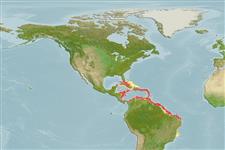
marino demersale; distribuzione batimetrica 26 - 340 m (Ref. 9626), usually 70 - 120 m (Ref. 55). Tropical; 25°N - 19°S, 87°W - 35°W (Ref. 54572)
Western Atlantic: throughout most of the Caribbean Sea from Cuba southward to northeastern Brazil. Frequently confused with Lutjanus campechanus. Also referred to as Lutjanus aya by past authors, but Rivas (Ref. 6409) proved that Bodianus aya Bloch, 1790 is not a lutjanid, but probably a sciaenid.
Lunghezza alla prima maturità / Dimensione / Peso / Età
Maturità: Lm 43.0, range 42 - ? cm
Max length : 100.0 cm TL maschio/sesso non determinato; (Ref. 55); common length : 65.0 cm TL maschio/sesso non determinato; (Ref. 55); peso massimo pubblicato: 10.0 kg (Ref. 5217); Età massima riportata: 18 anni (Ref. 55)
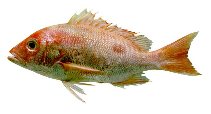
Spine dorsali (totale) : 10; Raggi dorsali molli (totale) : 14; Spine anali: 3; Raggi anali molli: 8 - 9. Head short, its dorsal profile somewhat rounded behind eye. Snout short and blunt. Eye large. Preopercular notch and knob weak. Pectoral fins long, reaching level of anus. Scale rows on back rising obliquely above lateral line. Back and upper side deep red; lower sides and belly rosy, with a silvery sheen; the fins mainly red. A small spot is sometimes on the lateral line below the anterior portion of the dorsal fin rays. Young with a rounded black spot on upper side below anterior dorsal soft rays, disappearing with growth.
Body shape (shape guide): fusiform / normal; Cross section: oval.
Adults inhabit rocky areas. They feed mainly on fishes, shrimps, crabs, cephalopods and planktonic items.
Allen, G.R., 1985. FAO Species Catalogue. Vol. 6. Snappers of the world. An annotated and illustrated catalogue of lutjanid species known to date. FAO Fish. Synop. 125(6):208 p. Rome: FAO. (Ref. 55)
Stato della Lista Rossa IUCN (Ref. 130435: Version 2025-2 (Global))
Minaccia per l'uomo
Reports of ciguatera poisoning (Ref. 31172)
Usi umani
Pesca: commerciale
Strumenti
Rapporti speciali
Scarica XML
Fonti Internet
Stime basate su modelli
Temperatura preferita (Fonte Biblio.
123201): 21.2 - 26.5, mean 24.8 °C (based on 38 cells).
Indice di diversità filogenetica (Fonte Biblio.
82804): PD
50 = 0.5000 [Uniqueness, from 0.5 = low to 2.0 = high].
Bayesian length-weight: a=0.01479 (0.01305 - 0.01677), b=2.96 (2.94 - 2.98), in cm total length, based on LWR estimates for this species (Ref.
93245).
Livello trofico (Fonte Biblio.
69278): 3.6 ±0.6 se; based on diet studies.
Resilienza (Fonte Biblio.
120179): Basso, tempo minimo di raddoppiamento della popolazione 4.5 - 14 anni (K=0.09-0.13; tm=5.5; tmax=18; Fec=2,693,173 (mean)).
Prior r = 0.48, 95% CL = 0.32 - 0.72, Based on 3 data-limited stock assessments.
Vulnerabilità della pesca (Ref.
59153): High vulnerability (60 of 100).
🛈
Vulnerabilità climatica (Ref.
125649): High to very high vulnerability (75 of 100).
🛈
Nutrienti (Ref.
124155): Calcium = 55 [29, 111] mg/100g; Iron = 0.512 [0.286, 1.003] mg/100g; Protein = 17.6 [16.0, 19.1] %; Omega3 = 0.209 [0.119, 0.358] g/100g; Selenium = 161 [77, 341] μg/100g; VitaminA = 25.5 [4.6, 118.8] μg/100g; Zinc = 0.399 [0.255, 0.618] mg/100g (wet weight); based on
nutrient studies.