>
Gobiiformes (Gobies) >
Gobiidae (Gobies) > Gobiinae
Etymology: Barbuligobius: Latin barba,-ae; barbula = beard + Latin, gobius = gudgeon (Ref. 45335).
Eponymy: James Erwin Böhlke (1930–1982) and his wife Eugenia Louisa Böhlke née Brandt (1929–2001) were both ichthyologists who worked at the Academy of Natural Sciences of Philadelphia, where he was Curator of Ichthyology (1954–1982). [...] (Ref. 128868), visit book page.
More on authors: Lachner & McKinney.
Umwelt: Milieu / Klimazone / Tiefenbereich / Verbreitungsgebiet
Ökologie
seewasser demersal; tiefenbereich 1 - 15 m (Ref. 90102). Tropical
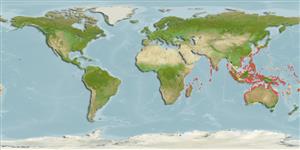
Indo-West Pacific.
Größe / Gewicht / Alter
Geschlechtsreife: Lm ? range ? - ? cm
Max length : 2.0 cm SL Männchen/unbestimmt; (Ref. 559)
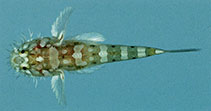
Rückenflossenstacheln (insgesamt) : 7; Rückenflossenweichstrahlen (insgesamt) : 8 - 9; Afterflossenstacheln: 1; Afterflossenweichstrahlen: 8 - 9. Characterized by light tan body color with row of five horizontally elongate black spots along middle of side; presence of row of smaller dark spots along lower side of body; nape, back and upper caudal peduncle with six brown saddles; joined pelvic fins, relatively long , extends beyond anal fin; rounded caudal fin; longitudinal scale series 23-25; absence of scales on nape, cheek, opercle, breast and anterior body; numerous, elongate, fleshy barbels and flaps on head; depth of body 5.6-6.3 in SL (Ref. 90102).
Body shape (shape guide): fusiform / normal.
Inhabits sand-rubble bottoms, usually in surge channels or on exposed outer edge of reefs in 1-15 m (Ref. 90102). Burrows in sand adjacent to coral or rock (Ref. 2798).
Lebenszyklus und Paarungsverhalten
Geschlechtsreife | Fortpflanzung | Ablaichen | Eier | Fruchtbarkeit | Larven
Hoese, D.F., 1986. Gobiidae. p. 774-807. In M.M. Smith and P.C. Heemstra (eds.) Smiths' sea fishes. Springer-Verlag, Berlin. (Ref. 2798)
IUCN Rote Liste Status (Ref. 130435: Version 2025-2 (Global))
Bedrohung für Menschen
Harmless
Nutzung durch Menschen
Tools
Zusatzinformationen
Download XML
Internet Quellen
Schätzungen auf der Grundlage von Modellen
Bevorzugte Temperatur (Ref.
123201): 22 - 29.3, mean 28.3 °C (based on 2614 cells).
Phylogenetischer Diversitätsindex (Ref.
82804): PD
50 = 1.0000 [Uniqueness, from 0.5 = low to 2.0 = high].
Bayesian length-weight: a=0.01023 (0.00477 - 0.02194), b=3.01 (2.83 - 3.19), in cm total length, based on LWR estimates for this (Sub)family-body shape (Ref.
93245).
Trophische Ebene (Ref.
69278): 3.0 ±0.3 se; based on size and trophs of closest relatives
Widerstandsfähigkeit (Ref.
120179): hoch, Verdopplung der Population dauert weniger als 15 Monate. (Preliminary K or Fecundity.).
Anfälligkeit der Fischerei (Ref.
59153): Low vulnerability (10 of 100).
🛈