>
Lophiiformes (Anglerfishes) >
Linophrynidae (Leftvents)
Etymology: Photocorynus: Greek, 'phos' or 'photos' = light + Greek, 'koryne' = club or mace (alluding to the unusually short and clublike illicium and esca of the genus) (Ref. 86949).
More on author: Regan.
Milieu: milieu / Klimaatzone / Diepte / verspreidingsgebied
Ecologie
marien bathypelagisch; diepte 990 - 1420 m (Ref. 86949). Deep-water
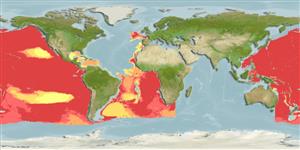
Western Atlantic: in tropical and subtropical waters. Also known from both sides of the Pacific Ocean.
Grootte / Gewicht / Leeftijd
Maturiteit: Lm ? range ? - ? cm
Max length : 1.0 cm TL mannelijk / geslacht onbekend; (Ref. 10762); 4.3 cm (female)
Korte beschrijving
Determinatiesleutels | Morfologie | Morfometrie
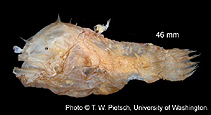
Metamorphosed females distinguished by the following characteristics: have spine on epiotic, pair of spines on postemporal and 5-6 spines on preopercle; frontals meet on midline, each with well-developed anterodorsal spine; moderately strong maxillae, jaws with numerous short teeth arranged in several series; absence of vomerine teeth; presence of first pharyngobranchial; ceratohyal lacking anterodorsal process; posterior margin of hypural plate is entire; extremely short ninth caudal fin ray, length of illicium less than 10%SL; esca nearly sessile on snout, without appendages; absence of hyoid barbell; second and third pectoral radials are subequal; darkly pigmented skin. Free-living juvenile males characterized by: lacking cranial and preopercular spines; preopercle not strongly curved; epiotic region of skull highly elevated; 8-9 teeth on each side of upper and lower jaws, all shorter than the denticular teeth; small denticular bones, placed slightly behind tip of jaws; slender denticular teeth, 3 on upper denticular and 3-4 on lower denticular; slightly tubular eyes, diameter 8-9% SL; moderately enlarged and inflated olfactory organs, nearly as large as eyes; 3 olfactory lamellae; skin unpigmented. Adult males characterized by: having skin that is very faintly pigmented; olfactory organs and to a lesser extent the eyes are degenerated; jaw teeth lost except in the lower jaw of one known specimen (Ref. 86949).
Body shape (shape guide): short and / or deep.
Also mesopelagic. Males dwarfed, becoming parasitic on females (Ref. 10762).
Levenscyclus en paargedrag
Maturiteit | Voortplanting | Paaien | Eieren | Fecunditeit | Larven
Bertelsen, E., 1990. Linophrynidae. p. 516-519. In J. C. Quero, J. C. Hureau, C. Karrer, A. Post and L. Saldanha (eds.) Check-list of the fishes of the eastern tropical Atlantic (CLOFETA). JNICT, Lisbon; SEI, Paris; and UNESCO, Paris. Vol. 1. (Ref. 10762)
Status op de Rode Lijst van het IUCN (Ref. 130435: Version 2025-2 (Global))
Gevaar voor de mens
Harmless
Gebruik door de mens
Tools
Speciale rapporten
Download XML
Internetbronnen
Schattingen op basis van modellen
Gewenste temperatuur (Ref.
123201): 2.4 - 3.5, mean 3.1 °C (based on 17 cells).
Fylogenetische diversiteitsindex (Ref.
82804): PD
50 = 1.0000 [Uniqueness, from 0.5 = low to 2.0 = high].
Bayesian length-weight: a=0.01995 (0.00906 - 0.04395), b=3.01 (2.83 - 3.19), in cm total length, based on all LWR estimates for this body shape (Ref.
93245).
Trofisch niveau (Ref.
69278): 3.7 ±0.5 se; based on size and trophs of closest relatives
Kwetsbaarheid van de visserij (Ref.
59153): Low vulnerability (10 of 100).
🛈