>
Blenniiformes (Blennies) >
Clinidae (Clinids)
Etymology: Xenopoclinus: Greek, xenos = strange + Greek, pous = feet + Greek, klinein, kline = sloping and bed, due to the four apophyses of sphenoid bone (Ref. 45335).
Eponymy: H J Koch from Somerset West, South Africa, was a malacologist who collected the holotype with his wife Anne during their field work in conchology. (Ref. 128868), visit book page.
More on author: Smith.
Entorno: milieu / zona climática / rango de profundidad / gama de distribución
Ecología
marino demersal; rango de profundidad 0 - 20 m (Ref. 28111). Subtropical
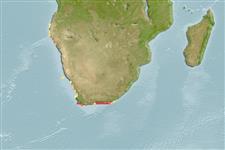
Southeast Atlantic: South Africa.
Tamaño / Peso / Edad
Madurez: Lm ? range ? - ? cm
Max length : 10.0 cm TL macho / no sexado; (Ref. 5496)
Descripción breve
Claves de identificación | Morfología | Morfometría
Espinas dorsales (total) : 33 - 37; Radios blandos dorsales (total) : 7 - 11; Espinas anales: 2; Radios blandos anales: 29 - 31.
Body shape (shape guide): elongated.
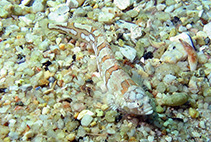
Inhabits intertidal sandy areas near kelp beds. Buries itself in the substrate by diving head first into the sediment and emerging slightly so that the top of the head and the dorsally-situated eyes protrude from the sediment surface. Alternatively, it may lie on the surface of the sediment and use the pectoral, pelvic and anal fins, together with undulatory movements of the body, to insinuate itself into the sediment in a fashion to that of Trachinus vipera. Again, only the top of the head and the eyes are left exposed. Once buried in the sediment, the fish remains there and is able to 'swim' through the sediment for short distances without re-emerging, although it occasionally emerges to undertake short forays (Ref. 28111)
Ciclo vital y comportamiento de apareamiento
Madurez | Reproducción | Puesta | Huevos | Fecundidad | Larva
Smith, M.M., 1986. Clinidae. p. 758-769. In M.M. Smith and P.C. Heemstra (eds.) Smiths' sea fishes. Springer-Verlag, Berlin. (Ref. 5496)
Situación en la Lista Roja de la UICN (Ref. 130435: Version 2025-2 (Global))
Amenaza para el ser humano
Harmless
Usos humanos
Herramientas
Informes especiales
Descargar XML
Fuentes de Internet
Estimaciones basadas en modelos
Temperatura preferida (Referencia
123201): 16.3 - 20.9, mean 18.1 °C (based on 47 cells).
Índice de diversidad filogenética (Referencia
82804): PD
50 = 0.7500 [Uniqueness, from 0.5 = low to 2.0 = high].
Bayesian length-weight: a=0.00501 (0.00221 - 0.01134), b=3.06 (2.86 - 3.26), in cm total length, based on LWR estimates for this (Sub)family-body shape (Ref.
93245).
Nivel trófico (Referencia
69278): 3.3 ±0.3 se; based on diet studies.
Resiliencia (Referencia
120179): Alto, población duplicada en un tiempo mínimo inferior a 15 meses (Preliminary K or Fecundity.).
Vulnerabilidad pesquera (Ref.
59153): Low vulnerability (10 of 100).
🛈