>
Blenniiformes (Blennies) >
Blenniidae (Combtooth blennies) > Salariinae
Etymology: Parablennius: Greek, para = the side of + Greek, blennios = mucus (Ref. 45335).
Ambiente: milieu / zona climática / intervalo de profundidade / gama de distribuição
Ecologia
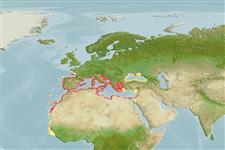
marinhas; estuarina demersal; intervalo de profundidade 3 - 15 m (Ref. 5981). Subtropical; 47°N - 9°N, 19°W - 42°E
Eastern Atlantic: coast of Portugal, Spain and Morocco south to Guinea. Also in all parts of the Mediterranean (except Syria, Lebanon, Israel and Egypt), in the Sea of Marmara and the Black Sea, and Canary Islands (Ref. 5981).
Tamanho / Peso / Idade
Maturidade: Lm ? range ? - ? cm
Max length : 15.0 cm TL macho/indeterminado; (Ref. 3397)
Descrição breve
Chaves de identificação | Morfologia | Morfometria
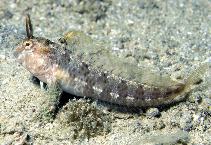
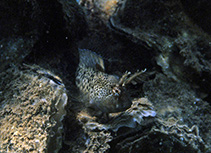
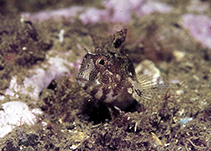
Facultative air-breathing in the genus (Ref. 126274); Adults occur over sandy bottoms with boulders and light vegetation. They hide in crevices where the nests are being guarded by the male (Ref. 5981). Oviparous. Eggs are demersal and adhesive (Ref. 205), and are attached to the substrate via a filamentous, adhesive pad or pedestal (Ref. 94114). Larvae are planktonic, often found in shallow, coastal waters (Ref. 94114).
Ciclo de vida e comportamento de acasalamento
Maturidade | Reprodução | Desova | Ovos | Fecundidade | Larvas
Oviparous (Ref. 205). Several females visit the hole to spawn with the resident male which guards the nest (Ref. 5981).
Bath, H., 1990. Blenniidae. p. 905-915. In J.C. Quero, J.C. Hureau, C. Karrer, A. Post and L. Saldanha (eds.) Check-list of the fishes of the eastern tropical Atlantic (CLOFETA). JNICT, Lisbon; SEI, Paris; and UNESCO, Paris. Vol. 2. (Ref. 5298)
Categoria na Lista Vermelha da IUCN (Ref. 130435: Version 2025-2 (Global))
Ameaça para o homem
Harmless
Utilização humana
Pescarias: sem interesse; Aquário: Espécies comerciais
Ferramentas
Relatórios especiais
Descarregue XML
Fontes da internet
Estimativas baseadas em modelos
Temperatura preferida (Ref.
123201): 16.1 - 21.7, mean 19.2 °C (based on 643 cells).
Índice de diversidade filogenética (Ref.
82804): PD
50 = 0.5000 [Uniqueness, from 0.5 = low to 2.0 = high].
Bayesian length-weight: a=0.00851 (0.00486 - 0.01489), b=2.90 (2.75 - 3.05), in cm total length, based on LWR estimates for this species & Genus-body shape (Ref.
93245).
Nível Trófico (Ref.
69278): 3.3 ±0.3 se; based on diet studies.
Resiliência (Ref.
120179): Elevada, tempo mínimo de duplicação da população menor que 15 meses (Preliminary K or Fecundity.).
Vulnerabilidade da pesca (Ref.
59153): Low vulnerability (10 of 100).
🛈
Nutrientes (Ref.
124155): Calcium = 115 [19, 351] mg/100g; Iron = 1.38 [0.53, 4.36] mg/100g; Protein = 4.03 [0.31, 7.75] %; Omega3 = 0.443 [0.188, 1.034] g/100g; Selenium = 9.83 [2.13, 28.31] μg/100g; VitaminA = 21.6 [8.6, 54.4] μg/100g; Zinc = 1.25 [0.60, 2.47] mg/100g (wet weight);