>
Blenniiformes (Blennies) >
Clinidae (Clinids)
Etymology: Xenopoclinus: Greek, xenos = strange + Greek, pous = feet + Greek, klinein, kline = sloping and bed, due to the four apophyses of sphenoid bone (Ref. 45335).
More on author: Smith.
Ambiente: milieu / zona climatica / distribuzione batimetrica / gamma di distribuzione
Ecologia
marino; salmastro demersale. Subtropical
Southeast Atlantic: Southern Africa from Orange River mouth to Algoa Bay.
Dimensione / Peso / Età
Maturità: Lm ? range ? - ? cm
Max length : 8.0 cm TL maschio/sesso non determinato; (Ref. 5496)
Breve descrizione
Chiavi di identificazione | Morfologia | Morfometria
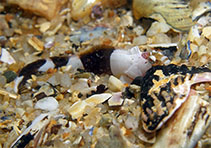
Spine dorsali (totale) : 31 - 36; Raggi dorsali molli (totale) : 7 - 12; Spine anali: 2; Raggi anali molli: 28 - 34. Head and anterior part of body whitish with sand-colored area from dorsal origin to eye and cheek; rest of the body light brown to dark red-brown above with large white saddles (Ref. 5496).
Body shape (shape guide): elongated.
Occurs over sand (Ref. 5496) and gravel (Ref. 28111) bottoms.
Ciclo vitale e comportamento di accoppiamento
Maturità | Riproduzione | Deposizione | Uova | Fecondità | Larve
Smith, M.M., 1986. Clinidae. p. 758-769. In M.M. Smith and P.C. Heemstra (eds.) Smiths' sea fishes. Springer-Verlag, Berlin. (Ref. 5496)
Stato della Lista Rossa IUCN (Ref. 130435: Version 2025-2 (Global))
Minaccia per l'uomo
Harmless
Usi umani
Strumenti
Rapporti speciali
Scarica XML
Fonti Internet
Stime basate su modelli
Indice di diversità filogenetica (Fonte Biblio.
82804): PD
50 = 0.7500 [Uniqueness, from 0.5 = low to 2.0 = high].
Bayesian length-weight: a=0.00501 (0.00221 - 0.01134), b=3.06 (2.86 - 3.26), in cm total length, based on LWR estimates for this (Sub)family-body shape (Ref.
93245).
Livello trofico (Fonte Biblio.
69278): 3.3 ±0.5 se; based on diet studies.
Resilienza (Fonte Biblio.
120179): Medio, tempo minimo di raddoppiamento della popolazione 1.4 - 4.4 anni (Fec assumed to be < 10,000).
Vulnerabilità della pesca (Ref.
59153): Low vulnerability (10 of 100).
🛈