>
Blenniiformes (Blennies) >
Tripterygiidae (Triplefin blennies) > Tripterygiinae
Etymology: Enneapterygius: Greek, ennea = nine times + Greek, pterygion = little fin (Ref. 45335).
Lingkungan: lingkungan / zona iklim / kisaran kedalaman / jangkauan distribusi
Ekologi
laut dasar (demersal); kisaran kedalaman 0 - 12 m (Ref. 12476), usually 0 - 1 m (Ref. 12476). Subtropical
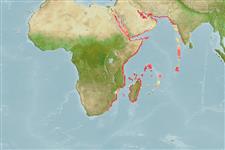
Western Indian Ocean: east and soitheast coast of South Africa (Transkei to southern Mozambique), the Red Sea, Aden, Oman, and Pakistan.
Ukuran / Berat / umur
Kematangan: Lm ? range ? - ? cm
Max length : 4.0 cm TL jantan/; (Ref. 11441)
deskripsi pendek
Kunci identifiaksi (pengenalan) | Morfologi | Morfometrik
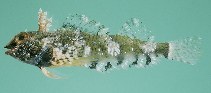
Duri punggung (Keseluruhan (total)) : 14 - 16; duri punggung lunak (Keseluruhan (total)) : 8 - 10; Duri dubur: 1; Sirip dubur lunak: 17 - 20. This species is distinguished by the following characters: D III + XI-XIII + 8-10 (usually III + XII + 10); A I,17-20 (usually 19); pectoral fin 14: 1-3, 4-6, 6-8 (usually 2, 5, 7). LL, pored scales 13-16, notched scales 21-25, starting at 2 scale rows below the end of the pored series; transverse scales 2/6; nape and abdomen scaleless, first dorsal fin base also without scales. Body depth 4.8-5.2 in SL. Head 3.4-4.0 in SL; eyes large, diameter 3.0-3.7 in head length; orbital cirrus moderate, lobate; supratemporal sensory canal U-shaped and embraces 1st dorsal spine; dentary pores 3+1+3. Male first dorsal fin slightly higher than second; slightly lower in females. Key features are: overall olive green; anal fins black and white barred. Males head black; first dorsal fin, lower pectoral-fin rays and proximal portion of the pelvic-fin rays yellow females (Ref. 57774, 88983).
Body shape (shape guide): elongated.
Female members of the Tripterygiidae have eggs that are hemispherical and covered with numerous sticky threads that anchor them in the algae on the nesting sites (Ref. 240). Larvae are planktonic which occur primarily in shallow, nearshore waters (Ref. 94114).
Holleman, W. and S.V. Bogorodsky, 2012. A review of the blennioid fish family Tripterygiidae (Perciformes) in the Red Sea, with description of Enneapterygius qirmiz, and reinstatement of Enneapterygius altipinnis Clark, 1980. Zootaxa 3152:36-60. (Ref. 88983)
Status IUCN Red List (Ref. 130435: Version 2025-2 (Global))
ancaman kepada manusia
Harmless
penggunaan manusia
Perikanan: tidak ada kepentingan
Alat, peralatan
laporan khas
muat turun XML
Sumber internet
Estimasi berdasarkan model
Suhu yang disukai (Acuan
123201): 24.8 - 28.9, mean 27.2 °C (based on 725 cells).
Indeks keanekaragaman filogenetik (Acuan
82804): PD
50 = 0.5000 [Uniqueness, from 0.5 = low to 2.0 = high].
Bayesian length-weight: a=0.00617 (0.00290 - 0.01310), b=3.04 (2.86 - 3.22), in cm total length, based on LWR estimates for this (Sub)family-body shape (Ref.
93245).
Tingkat Trofik (Acuan
69278): 3.1 ±0.3 se; based on size and trophs of closest relatives
Daya lenting (Acuan
120179): Tinggi, Waktu penggandaan populasi minimum kurang dari 15 bulan (Preliminary K or Fecundity.).
Kerentanan Penangkapan Ikan (Ref.
59153): Low vulnerability (10 of 100).
🛈