>
Scombriformes (Mackerels) >
Chiasmodontidae (Snaketooth fishes)
Etymology: Kali: Named after Kali, a Hindu goddess.
Eponymy: Kali, also known as Kālikā (‘the black one’) is a Hindu goddess, often depicted as having four arms. (Ref. 128868), visit book page.
Entorno: milieu / zona climática / rango de profundidad / gama de distribución
Ecología
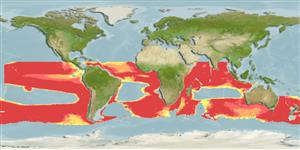
marino batipelágico; rango de profundidad 1000 - 3300 m (Ref. 75596), usually 1400 - 2500 m (Ref. 75596). Deep-water; 16°N - 60°S (Ref. 75596)
Circumglobal in equatorial, tropical, subtropical, temperate and subpolar regions: Atlantic Ocean (40° N to 40° S); Indian Ocean (from the type locality, 16°56’ N, 92°33’ E); Pacific Ocean (31° N to 43° S); Southern Ocean (50° S-60° S).
Tamaño / Peso / Edad
Madurez: Lm ? range ? - ? cm
Max length : 26.2 cm SL macho / no sexado; (Ref. 6944)
Descripción breve
Claves de identificación | Morfología | Morfometría
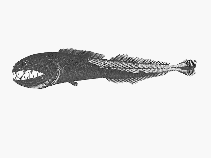
Espinas dorsales (total) : 11 - 14; Radios blandos dorsales (total) : 21 - 25; Espinas anales: 1; Radios blandos anales: 22 - 26. This species is distinguished from its congeners K. falx by the teeth in lateral series of premaxilla 7-11, caniniform, elongated, slightly curved, type 4, widely spaced (vs. teeth in lateral series of premaxilla 13-33; recurved, with ventral attachment, closely spaced in K. parri; needle-like, closely spaced in K. kerberti and K. macrodon and anterior part fourth of K. normani; caniniform but not very elongated in K. colubrina); first tooth of lateral series of premaxilla longest, with tight type 4 attachment (vs. first tooth of lateral series of premaxilla not remarkably enlarged, smaller than adjacent teeth, with loose types 4 attachment or with ventral attachment to bone); teeth in mesial series of premaxilla 3, fang-like (vs. 4 or 15; not fang-like in K. macrura, K. parri, K. colubrina); teeth in lateral series of dentary 6-8, very elongated, curved, type 4, widely spaced (vs. 12-32; recurved, with ventral attachment, closely spaced in K. parri, needle-like, closely spaced in K. kerberti and K. macrodon and anterior part fourth of K. normani; recurved in K. colubrina). This species can be further distinguished from K. falx by the larger eye, orbit width 15.4-22.7% and orbit height 12.5-18% in head length (vs. eye small, orbit width 11.2-16.0% and orbit height 9.7-12.4% in head length); basihyal elongated and straight, pointing forward (vs. basihyal reduced, strongly curved, pointing ventrally); first tooth in lateral series of premaxilla enlarged, 15.2-16.4 % in premaxillary length, slightly curved, not projecting anteriorly (vs. first tooth remarkably enlarged, 17.2-20.5% in premaxillary length, sickle-shaped, projecting anteriorly); first tooth in mesial series of premaxilla anterior to level of anterior nostril, and to second tooth of lateral series (vs. first tooth below level of anterior nostril, and beside second tooth of lateral series); first tooth in mesial series of dentary beside second tooth of lateral series (vs. first tooth between second and third teeth in lateral series) (Ref. 75596).
Body shape (shape guide): elongated.
The shallowest depth record is based on a single Gargaropteron-staged individual which was taken in the Yucatan Channel, in 0-124 m (Museum: RHB 1290).
Ciclo vital y comportamiento de apareamiento
Madurez | Reproducción | Puesta | Huevos | Fecundidad | Larva
Melo, M.R.S., 2008. The genus Kali Lloyd (Chiasmodontidae: Teleostei) with description of new two species, and the revalidation of K. kerberti Weber. Zootaxa 1747:1-33. (Ref. 75596)
Situación en la Lista Roja de la UICN (Ref. 130435: Version 2025-2 (Global))
Amenaza para el ser humano
Harmless
Usos humanos
Pesquerías: sin interés
Herramientas
Informes especiales
Descargar XML
Fuentes de Internet
Estimaciones basadas en modelos
Temperatura preferida (Referencia
123201): 1.8 - 4.2, mean 2.5 °C (based on 2804 cells).
Índice de diversidad filogenética (Referencia
82804): PD
50 = 0.5078 [Uniqueness, from 0.5 = low to 2.0 = high].
Bayesian length-weight: a=0.00389 (0.00180 - 0.00842), b=3.12 (2.94 - 3.30), in cm total length, based on all LWR estimates for this body shape (Ref.
93245).
Nivel trófico (Referencia
69278): 3.8 ±0.2 se; based on size and trophs of closest relatives
Vulnerabilidad pesquera (Ref.
59153): Low vulnerability (22 of 100).
🛈