Klassifizierung / Names
Namen | Synonyme | Catalog of Fishes(Gattung, Arten) | ITIS | CoL | WoRMS | Cloffa
>
Eupercaria/misc (Various families in series Eupercaria) >
Cepolidae (Bandfishes) > Owstoniinae
Etymology: Owstonia: Named for Alan Owston (1853‒1915), an amateur naturalist, yachtsman and collector of Asian wildlife, notably fishes from Japan and China; simotera: Name from Latin 'simoter' for snub-nosed.
Eponymy: Alan Owston (1853–1915) was an English businessman who was a collector of Asian wildlife, as well as a yachtsman. [...] (Ref. 128868), visit book page.
More on author: Smith.
Umwelt: Milieu / Klimazone / Tiefenbereich / Verbreitungsgebiet
Ökologie
seewasser bathydemersal; tiefenbereich 450 - 549 m (Ref. 119093). Deep-water
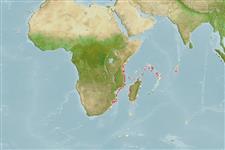
Western Indian Ocean: southern Mozambique.
Größe / Gewicht / Alter
Geschlechtsreife: Lm ? range ? - ? cm
Max length : 29.8 cm SL Männchen/unbestimmt; (Ref. 119093)
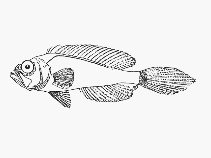
Rückenflossenstacheln (insgesamt) : 3; Rückenflossenweichstrahlen (insgesamt) : 21; Afterflossenstacheln: 1; Afterflossenweichstrahlen: 14. Body and fins red or crimson in color.
Body shape (shape guide): elongated.
Lebenszyklus und Paarungsverhalten
Geschlechtsreife | Fortpflanzung | Ablaichen | Eier | Fruchtbarkeit | Larven
Smith-Vaniz, W.F. and G.D. Johnson, 2016. Hidden diversity in deep-water bandfishes: review of Owstonia with descriptions of twenty-one new species (Teleostei: Cepolidae: Owstoniinae). Zootaxa 4187(1):1-103. (Ref. 119093)
IUCN Rote Liste Status (Ref. 130435: Version 2025-2 (Global))
Bedrohung für Menschen
Harmless
Nutzung durch Menschen
Fischereien: bycatch
Tools
Zusatzinformationen
Download XML
Internet Quellen
Schätzungen auf der Grundlage von Modellen
Bevorzugte Temperatur (Ref.
123201): 10.4 - 11.3, mean 10.8 °C (based on 3 cells).
Phylogenetischer Diversitätsindex (Ref.
82804): PD
50 = 0.5000 [Uniqueness, from 0.5 = low to 2.0 = high].
Bayesian length-weight: a=0.00389 (0.00180 - 0.00842), b=3.12 (2.94 - 3.30), in cm total length, based on all LWR estimates for this body shape (Ref.
93245).
Trophische Ebene (Ref.
69278): 3.4 ±0.4 se; based on size and trophs of closest relatives
Widerstandsfähigkeit (Ref.
120179): mittel, Verdopplung der Population dauert 1,4 - 4,4 Jahre. (Preliminary K or Fecundity.).
Anfälligkeit der Fischerei (Ref.
59153): Low to moderate vulnerability (26 of 100).
🛈