>
Ovalentaria/misc (Various families in series Ovalentaria) >
Opistognathidae (Jawfishes)
Etymology: Opistognathus: Greek, opisthe = behind + Greek, gnathos = jaw (Ref. 45335); to the very elongate upper jaw of the type species of the genus, Opistognathus nigromarginatus (Ref. 128653); nigromarginatus: Name from Latin 'nigro' or black and 'marginatus' meaning enclosed with a border; refers to the conspicuous inner maxillary stripe of this species.
More on author: Rüppell.
Ambiente: milieu / zona climatica / distribuzione batimetrica / gamma di distribuzione
Ecologia
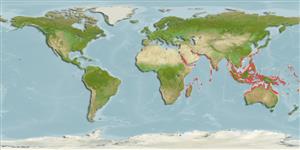
marino demersale; distribuzione batimetrica 2 - 17 m (Ref. 90102). Tropical; 30°N - 12°S, 35°E - 100°E (Ref. 121151)
Indo-Pacific: Red Sea and eastern Africa to the South China Sea.
Dimensione / Peso / Età
Maturità: Lm ? range ? - ? cm
Max length : 18.6 cm TL maschio/sesso non determinato; (Ref. 5468)
Breve descrizione
Chiavi di identificazione | Morfologia | Morfometria
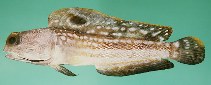
Spine dorsali (totale) : 11; Raggi dorsali molli (totale) : 14 - 15; Spine anali: 3; Raggi anali molli: 14 - 15. This species is distinguished by the following characters: elongate supramaxilla and posterior end of maxilla produced as a thin flexible lamina, in adults it usually extends almost to or beyond rear margin of opercle; dorsal fin with an ocellated spot between third or fourth and eighth spines; inner lining of upper jaw and adjacent membranes with a single conspicuous black stripe that touches ventral margin of maxilla for most of its length; D Xl,14 or 15 (exceptionally 15); body with about 68-95 oblique scale rows; total gill rakers 36-45, usually 39-45 (Ref. 81517).
Body shape (shape guide): elongated; Cross section: oval.
Inhabits burrows in shallow coastal waters. Also found in sand/rubble bottoms in 2-17 m (Ref 90102).
Ciclo vitale e comportamento di accoppiamento
Maturità | Riproduzione | Deposizione | Uova | Fecondità | Larve
Smith-Vaniz, W.F., 1986. Opisthognathidae. p. 726-727. In M.M. Smith and P.C. Heemstra (eds.) Smiths' sea fishes. Springer-Verlag, Berlin. (Ref. 5468)
Stato della Lista Rossa IUCN (Ref. 130435: Version 2025-2 (Global))
Minaccia per l'uomo
Harmless
Usi umani
Strumenti
Rapporti speciali
Scarica XML
Fonti Internet
Stime basate su modelli
Temperatura preferita (Fonte Biblio.
123201): 25.3 - 29.2, mean 28.5 °C (based on 2714 cells).
Indice di diversità filogenetica (Fonte Biblio.
82804): PD
50 = 0.5000 [Uniqueness, from 0.5 = low to 2.0 = high].
Bayesian length-weight: a=0.00389 (0.00180 - 0.00842), b=3.12 (2.94 - 3.30), in cm total length, based on all LWR estimates for this body shape (Ref.
93245).
Livello trofico (Fonte Biblio.
69278): 3.4 ±0.45 se; based on food items.
Vulnerabilità della pesca (Ref.
59153): Low vulnerability (10 of 100).
🛈