>
Lophiiformes (Anglerfishes) >
Oneirodidae (Dreamers)
Etymology: Danaphryne: In commemoration of the Royal Danish Research Vessel 'Dana' (Ref. 86949).
Eponymy: The succession of Danish research vessels named ‘Dana’ seem to have been greatly favoured by describers of fish, and often the etymology includes: “…from which the holotype was collected. [...] (Ref. 128868), visit book page.
More on authors: Regan & Trewavas.
Umwelt: Milieu / Klimazone / Tiefenbereich / Verbreitungsgebiet
Ökologie
seewasser bathypelagisch; tiefenbereich 0 - 2000 m (Ref. 86949). Deep-water
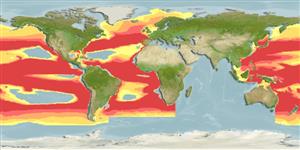
Tropical to temperate parts of all oceans.
Größe / Gewicht / Alter
Geschlechtsreife: Lm ? range ? - ? cm
Max length : 10.5 cm SL (female)
Kurzbeschreibung
Bestimmungsschlüssel | Morphologie | Morphometrie
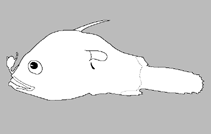
Rückenflossenweichstrahlen (insgesamt) : 5 - 7; Afterflossenweichstrahlen: 4 - 5. Metamorphosed females distinguished by the following characteristics: narrow snout, width of ethmoid cartilage and vomer considerably less than the distance between anterolateral tips of the lateral ethmoids and frontals; frontals short, lying posterior to the ethmoid region, dorsal margin convex; frontals separated from prootics; presence of vomerine teeth; large and nearly circular nasal foramina; presence of pterosphenoid; anterior end of illicial trough wider and shallower than the posterior end; well developed sphenotic spines; symphysial cartilage of upper jaw longer than wide; lower jaw with well developed symphysial spine; hyomandibula with double head; well developed quadrate spine, longer than articular spine; deeply notched posterior margin of opercle; long and narrow subopercle, dorsal end long and slender, tapering to a point, ventral end nearly circular; absence of first pharyngobranchial; well developed second pharyngobranchial; second hypobranchial articulates directlywith second basibranchial; caudal fin rays without internal pigmentation; illicium longer than length of escal bulb; pterygiophore of illicium cylindrical throughout length, emerging on snout from between frontal bones, anterior end exposed, posterior end concealed beneath skin; well developed first ray of dorsal fin; dorsal fin rays 5-7; anal fin rays 4-5; short and broad pectoral fin lobe, shorter than longest rays of pectoral fin; pectoral fin rays 16-19; coracoid lacking posteroventral process; simple pelvic bones, expanded distally; skin smooth and naked, without dermal spinules; darkly pigmented skin of caudal peduncle extends well past base of caudal fin (Ref. 86949).
Also mesopelagic (Ref. 10524).
Lebenszyklus und Paarungsverhalten
Geschlechtsreife | Fortpflanzung | Ablaichen | Eier | Fruchtbarkeit | Larven
Bertelsen, E., 1990. Oneirodidae. p. 498-507. In J.C. Quero, J.C. Hureau, C. Karrer, A. Post, and L. Saldanha (eds.) Check-list of the fishes of the eastern tropical Atlantic (CLOFETA). JNICT, Lisbon; SEI, Paris; and UNESCO, Paris. Vol. 1. (Ref. 10524)
IUCN Rote Liste Status (Ref. 130435: Version 2025-2 (Global))
Bedrohung für Menschen
Harmless
Nutzung durch Menschen
Tools
Zusatzinformationen
Download XML
Internet Quellen
Schätzungen auf der Grundlage von Modellen
Bevorzugte Temperatur (Ref.
123201): 1 - 13.3, mean 6.7 °C (based on 2192 cells).
Phylogenetischer Diversitätsindex (Ref.
82804): PD
50 = 1.0000 [Uniqueness, from 0.5 = low to 2.0 = high].
Bayesian length-weight: a=0.01995 (0.00906 - 0.04395), b=3.01 (2.83 - 3.19), in cm total length, based on all LWR estimates for this body shape (Ref.
93245).
Trophische Ebene (Ref.
69278): 3.9 ±0.6 se; based on size and trophs of closest relatives
Widerstandsfähigkeit (Ref.
120179): hoch, Verdopplung der Population dauert weniger als 15 Monate. (Preliminary K or Fecundity.).
Anfälligkeit der Fischerei (Ref.
59153): Low vulnerability (10 of 100).
🛈