>
Lophiiformes (Anglerfishes) >
Caulophrynidae (Fanfins)
Etymology: Caulophryne: Greek, 'kaulos' or 'caulis' = stem + Greek, 'phryne' = toad (according to Goode and Bean (1896): "a 'phryne'-like fish with the cephalic tentacle supported on a stemlike base") ( Ref. 86949).
More on author: Regan.
Umwelt: Milieu / Klimazone / Tiefenbereich / Verbreitungsgebiet
Ökologie
seewasser bathypelagisch; tiefenbereich 900 - 1250 m (Ref. 58302). Deep-water
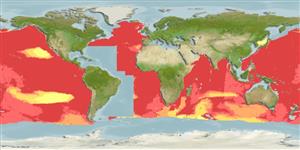
Eastern Atlantic: a single female with a parasitic male recorded from northeast of the Azores (Ref. 13584) and one record east of Cape Verde; reported from Iceland (Ref. 12462) and Namibia (Ref. 27121). Also known from the northwest Atlantic and Indo-Pacific.
Größe / Gewicht / Alter
Geschlechtsreife: Lm ? range ? - ? cm
Max length : 21.0 cm TL Männchen/unbestimmt; (Ref. 41039)
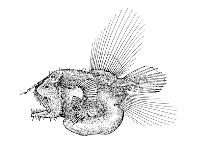
Rückenflossenweichstrahlen (insgesamt) : 19 - 22; Afterflossenweichstrahlen: 17 - 19. Metamorphosed females distinguished by the following characteristics: illicium with numerous elongate translucent filaments along length; length of illicium 15.7-32.1%SL; illicium lightly pigmented along anterior margin, bearing numerous elongate translucent filaments, most of which arise from posterior margin; esca consisting of posterolateral appendage with palmate, opaque, distal tip and tapering terminal appendage with opaque distal tip; highly filamentous escal appendages in specimens larger than 44 mm, number and length of filaments reduced in smaller specimens; dorsal fin rays 19-22; anal fin rays 17-19; pectoral fin rays 15-18; upper jaw teeth 26-45; lower jaw teeth 16-32; teeth on vomer 1-3 (Ref. 86949).
Body shape (shape guide): short and / or deep.
Meso- and bathypelagic at 0-2000 m fishing depths (Ref. 58302).
Lebenszyklus und Paarungsverhalten
Geschlechtsreife | Fortpflanzung | Ablaichen | Eier | Fruchtbarkeit | Larven
Bertelsen, E., 1990. Caulophrynidae. p. 491. In J.C. Quero, J.C. Hureau, C. Karrer, A. Post and L. Saldanha (eds.) Check-list of the fishes of the eastern tropical Atlantic (CLOFETA). JNICT, Lisbon; SEI, Paris; and UNESCO, Paris. Vol. 1. (Ref. 7398)
IUCN Rote Liste Status (Ref. 130435: Version 2025-2 (Global))
Bedrohung für Menschen
Harmless
Nutzung durch Menschen
Tools
Zusatzinformationen
Download XML
Internet Quellen
Schätzungen auf der Grundlage von Modellen
Bevorzugte Temperatur (Ref.
123201): 3.2 - 5.8, mean 4.5 °C (based on 292 cells).
Phylogenetischer Diversitätsindex (Ref.
82804): PD
50 = 0.5938 [Uniqueness, from 0.5 = low to 2.0 = high].
Bayesian length-weight: a=0.01995 (0.00906 - 0.04395), b=3.01 (2.83 - 3.19), in cm total length, based on all LWR estimates for this body shape (Ref.
93245).
Trophische Ebene (Ref.
69278): 4.0 ±0.5 se; based on size and trophs of closest relatives
Anfälligkeit der Fischerei (Ref.
59153): Low vulnerability (11 of 100).
🛈