>
Perciformes/Scorpaenoidei (Scorpionfishes) >
Scorpaenidae (Scorpionfishes or rockfishes) > Scorpaeninae
Etymology: Neoscorpaena: Greek, neos = new + see under genus Scorpaena.
Eponymy: Jørgen G Nielsen (d: 1932) is a Danish zoologist. [...] (Ref. 128868), visit book page.
More on author: Smith.
Environnement : milieu / zone climatique / profondeur / gamme de distribution
Écologie
marin démersal; profondeur 40 - 507 m (Ref. 86966). Subtropical
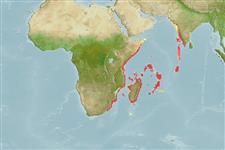
Western Indian Ocean: South Africa, Madagascar, the Seychelles and Réunion.
Taille / Poids / Âge
Maturité: Lm ? range ? - ? cm
Max length : 21.6 cm SL mâle / non sexé; (Ref. 86966)
Description synthétique
Clés d'identification | Morphologie | Morphométrie
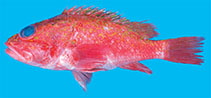
Épines dorsales (Total) : 12; Rayons mous dorsaux (Total) : 9 - 11; Épines anales: 3; Rayons mous anaux: 5; Vertèbres: 26. This species is characterized by the following: D XII, 9-11 (usually 10); A III,5; pelvic-fin rays I,5; pectoral-fin rays 18 on each side of body (asymmetrically 17 and 18 in one specimen); Longitudinal scale series 32-37; pored lateral-line scales 23-25 (usually 25); scale rows above lateral line 4-5 (usually 5) and below 10; scale rows between last dorsal-fin spine base and lateral line 4-5 (usually 5); 6 scale rows between sixth dorsal-fin spine base and lateral line; 6-8 predorsal scales; gill rakers on upper limb 5-7, lower limb 12-13, total 17-20 (usually 18); 26 vertebrae (based on MNHN 2003-291); head length 45.9-48.6% of SL; orbit diameter 12.0-17.1% of SL (value significantly decreasing with growth); interorbital width at middle of eye 4.4-5.8% of SL; lateral lacrimal spine absent; anterior lacrimal spine rounded, not spinous shape; posterior lacrimal spine triangular; suborbital spines 4-8; preopercular spines 5, with an additional spine on uppermost spine; preocular, supraocular, postocular, and tympanic spines are well developed; interorbital ridges joined posteriorly to tympanic spine bases; no parietal spine; the large and well developed nuchal spine originating from posterior end of tympanic spine; absence of interorbital, coronal and pretympanic spines; occiput nearly flat, without pit; sphenotic spines 2-13; parietal, lower posttemporal and supracleithral spines well developed; no upper posttemporal spine, but a small spine occurring between nuchal and lower posttemporal spines; posterior margin of maxilla just short of or reaching a vertical through posterior margin of orbit; with teeth on vormer and palatines; pectoral fin bilobed; usually a large black blotch on dorsal fin basally between fifth-seventh and tenth spines (lacking the blotch in some specimens); body is strongly mottled, especially dorsally (Ref. 86966).
Body shape (shape guide): fusiform / normal; Cross section: compressed.
Cycle de vie et comportement reproducteur
Maturité | Reproduction | Frai | Œufs | Fécondité | Larves
Motomura, H., P. Béarez and R. Causse, 2011. Review of Indo-Pacific specimens of the subfamily Scorpaeninae (Scorpaenidae), deposited in the Muséum national d’Histoire naturelle, Paris, with description of a new species of Neomerinthe. Cybium 35(1):55-73. (Ref. 86966)
Statut dans la liste rouge de l'IUCN (Ref. 130435: Version 2025-2 (Global))
Menace pour l'homme
Harmless
Utilisations par l'homme
Outils
Articles particuliers
Télécharger en XML
Sources Internet
Estimations basées sur des modèles
Température préférée (Réf.
123201): 15.3 - 17.9, mean 16.8 °C (based on 4 cells).
Indice de diversité phylogénétique (Réf.
82804): PD
50 = 1.0000 [Uniqueness, from 0.5 = low to 2.0 = high].
Bayesian length-weight: a=0.01288 (0.00626 - 0.02652), b=3.02 (2.85 - 3.19), in cm total length, based on LWR estimates for this (Sub)family-body shape (Ref.
93245).
Niveau trophique (Réf.
69278): 3.9 ±0.6 se; based on size and trophs of closest relatives
Résilience (Réf.
120179): Milieu, temps minimum de doublement de population : 1,4 à 4,4 années (Preliminary K or Fecundity.).
Vulnérabilité de la pêche (Ref.
59153): Low vulnerability (16 of 100).
🛈