Environnement : milieu / zone climatique / profondeur / gamme de distribution
Écologie
marin bathydémersal; profondeur 274 - 550 m (Ref. 58302). Deep-water
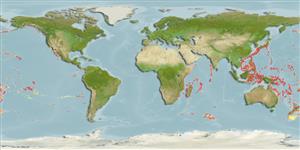
Indo-West Pacific: widespread, off South Africa, New Caledonia, Taiwan and Japan, Hawaii.
Taille / Poids / Âge
Maturité: Lm ? range ? - ? cm
Max length : 9.3 cm SL mâle / non sexé; (Ref. 559)
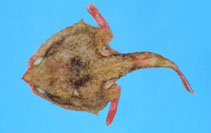
Épines dorsales (Total) : 0; Rayons mous dorsaux (Total) : 6; Épines anales: 0; Rayons mous anaux: 4; Vertèbres: 18. Preserved specimens with dusky tan dorsally, pale ventrally. Centers of scales flecked with black around bases of apical spines (Ref. 6612). Tubercles on dorsal surface of disk with simple spines, elsewhere on body with multi-spined tubercles, especially prominent on principal tubercles of tail; fins without tubercles. Rostrum with a large multifold median spine protruding beyond its neighbors, terminating in 5 or more flaring spinelets (Ref. 40826).
Body shape (shape guide): short and / or deep; Cross section: flattened.
Bathymetric range possibly up to 900 m (Ref. 40826). Benthic (Ref. 58302).
Cycle de vie et comportement reproducteur
Maturité | Reproduction | Frai | Œufs | Fécondité | Larves
Bradbury, M.G., 1986. Ogcocephalidae. p. 370-373. In M.M. Smith and P.C. Heemstra (eds.) Smiths' sea fishes. Springer-Verlag, Berlin. (Ref. 6612)
Statut dans la liste rouge de l'IUCN (Ref. 130435: Version 2025-2 (Global))
Menace pour l'homme
Harmless
Utilisations par l'homme
Outils
Articles particuliers
Télécharger en XML
Sources Internet
Estimations basées sur des modèles
Température préférée (Réf.
123201): 2 - 13.5, mean 10.2 °C (based on 169 cells).
Indice de diversité phylogénétique (Réf.
82804): PD
50 = 0.6250 [Uniqueness, from 0.5 = low to 2.0 = high].
Bayesian length-weight: a=0.02455 (0.01000 - 0.06026), b=2.94 (2.73 - 3.15), in cm total length, based on LWR estimates for this (Sub)family-body shape (Ref.
93245).
Niveau trophique (Réf.
69278): 3.3 ±0.5 se; based on size and trophs of closest relatives
Résilience (Réf.
120179): Milieu, temps minimum de doublement de population : 1,4 à 4,4 années (Preliminary K or Fecundity.).
Vulnérabilité de la pêche (Ref.
59153): Low vulnerability (10 of 100).
🛈