>
Aulopiformes (Grinners) >
Scopelarchidae (Pearleyes)
Etymology: Scopelarchus: Greek, skopelos = a lantern fish + Greek, archos = anus (Ref. 45335).
Eponymy: ‘Michael Sars’ was the name of the Norwegian research vessel from which the holotypes were collected. The vessel was named after the Norwegian theologian and biologist Michael Sars (1805–1869). (Ref. 128868), visit book page.
Environnement : milieu / zone climatique / profondeur / gamme de distribution
Écologie
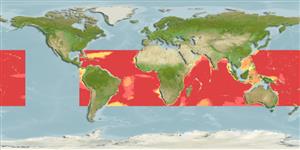
marin bathypélagique; océanodrome (Ref. 51243); profondeur 256 - 500 m (Ref. 58302). Deep-water; 30°N - 37°S, 85°W - 150°W
Atlantic, Indian and Pacific: in tropical and subtropical waters; widespread between 30°N to 0° in the eastern Atlantic, unknown from the Gulf of Guinea/Benguela Current area. Does not occur in the Mediterranean Sea and in the eastern Pacific east of 150°W.
Taille / Poids / Âge
Maturité: Lm ? range ? - ? cm
Max length : 10.2 cm SL mâle / non sexé; (Ref. 10755)
Description synthétique
Clés d'identification | Morphologie | Morphométrie
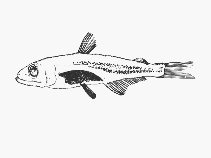
Épines dorsales (Total) : 0; Rayons mous dorsaux (Total) : 7 - 9; Épines anales: 0; Rayons mous anaux: 18 - 21. Medial face of pectorals with dense black pigment (Ref. 6601).
Body shape (shape guide): fusiform / normal.
Oceanic and mesopelagic (Ref. 6601, 58302). Most adults are taken in hauls to depths exceeding 500 m, none in hauls to depths less than 250 m. Larvae are taken year-round throughout its range, chiefly in hauls to depths less than 200 and apparently not in hauls restricted to the upper 100 m (Ref. 10755). Adults are presumed to prey on other midwater fishes. Synchronous hermaphrodites (Ref. 6691).
Cycle de vie et comportement reproducteur
Maturité | Reproduction | Frai | Œufs | Fécondité | Larves
Johnson, R.K., 1990. Scopelarchidae. p. 393-397. In J. C. Quero, J. C. Hureau, C. Karrer, A. Post and L. Saldanha (eds.) Check-list of the fishes of the eastern tropical Atlantic (CLOFETA). JNICT, Lisbon; SEI, Paris; and UNESCO, Paris. Vol. 1. (Ref. 10755)
Statut dans la liste rouge de l'IUCN (Ref. 130435: Version 2025-2 (Global))
Menace pour l'homme
Harmless
Utilisations par l'homme
Pêcheries: sans intérêt
Outils
Articles particuliers
Télécharger en XML
Sources Internet
Estimations basées sur des modèles
Température préférée (Réf.
123201): 8.7 - 9.4, mean 9 °C (based on 12 cells).
Indice de diversité phylogénétique (Réf.
82804): PD
50 = 0.5625 [Uniqueness, from 0.5 = low to 2.0 = high].
Bayesian length-weight: a=0.01122 (0.00514 - 0.02450), b=3.04 (2.87 - 3.21), in cm total length, based on all LWR estimates for this body shape (Ref.
93245).
Niveau trophique (Réf.
69278): 4.2 ±0.73 se; based on food items.
Vulnérabilité de la pêche (Ref.
59153): Low vulnerability (10 of 100).
🛈