>
Clupeiformes (Herrings) >
Engraulidae (Anchovies) > Engraulinae
Etymology: Engraulis: Greek, eggraulis, -eos = anchovy (Ref. 45335).
More on authors: Hubbs & Marini.
Miljö: miljö / Klimatzon / djupintervall / distributionsområde
Ekologi
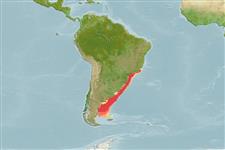
marina pelagic-neritic; havsvandrande (Ref. 51243); djupintervall 30 - 200 m (Ref. 189). Subtropical; 21°S - 50°S, 67°W - 34°W (Ref. 54431)
Southwest Atlantic: north of Rio de Janeiro, Brazil to San Jorge Gulf, Argentina.
Längd vid första mognad / Storlek / Vikt / Ålder
Könsmognad: Lm 9.2, range 8 - 10.2 cm
Max length : 17.0 cm SL hane/ej könsbestämd; (Ref. 189); publicerad maxvikt: 25.00 g (Ref. 4883)
Kort beskrivning
Bestämningsnycklar | Morfologi | Morfometri
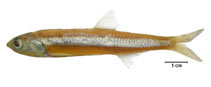
Taggstrålar i ryggfenan (totalt) : 0; Mjukstrålar i ryggfenan (totalt) : 15 - 16; Taggstrålar i analfenan: 0; Mjukstrålar i analfenan: 17 - 21. Snout prominent, pointed, about 3/4 eye diameter; maxilla moderate, tip bluntly tapering or a little rounded, reaching to front margin of pre-operculum, extending a little beyond tip of second supra-maxilla; teeth in jaws numerous, small. Lower gill rakers long and slender; no gill rakers on hind face of third epibranchial; pseudobranch long, reaching onto inner face of operculum (Ref.189). Blackish blue dorsally, silvery white laterally and ventrally. All fins transparent (Ref. 27363).
Body shape (shape guide): elongated; Cross section: oval.
Occurs in coastal waters to about 800 km or more from the shore, forming dense schools at about 30 to 90 m depth in summer, but down to 100 to 200 m during winter. Feeds as juveniles on zooplankton, but with phytoplankton becoming increasingly important. Spawns throughout the year, most intensely and close to shore in October or November and again in May or June but less intensely and more offshore. Exhibits north-south and near shore-offshore migrations. During winter as the most favorable feeding period for larvae which occurs in the continental shelf in the extreme south of Brazil (Ref. 53892). Consumed fresh or canned (Ref. 4931).Typical size 7-13 cm SL (Ref. 47377).
Livscykel och parningsbeteende
Könsmognad | Reproduktion | Lek | Ägg | Fekunditet | Larver
Whitehead, P.J.P., G.J. Nelson and T. Wongratana, 1988. FAO Species Catalogue. Vol. 7. Clupeoid fishes of the world (Suborder Clupeoidei). An annotated and illustrated catalogue of the herrings, sardines, pilchards, sprats, shads, anchovies and wolf-herrings. FAO Fish. Synop. 125(7/2):305-579. Rome: FAO. (Ref. 189)
Status på IUCN:s rödlista (Ref. 130435: Version 2025-2 (Global))
Hot mot människor
Harmless
Mänskliga användningsområden
Fiskeri: kommersiellt viktig
Verktyg
Särskilda rapporter
Ladda ner XML
Internet-källor
Uppskattningar baserade på modeller
Önskad temperatur (Ref.
123201): 4.6 - 18.7, mean 8.2 °C (based on 187 cells).
Index för fylogenetisk mångfald (Ref.
82804): PD
50 = 0.5020 [Uniqueness, from 0.5 = low to 2.0 = high].
Bayesian length-weight: a=0.00490 (0.00374 - 0.00641), b=3.14 (3.10 - 3.18), in cm total length, based on LWR estimates for this species (Ref.
93245).
Trofisk nivå (Ref.
69278): 2.5 ±0.00 se; based on food items.
Resiliens (Ref.
120179): Mellan, lägsta populationsfördubblingstid 1,4-4,4 år (K=0.2-0.3).
Prior r = 0.56, 95% CL = 0.37 - 0.84, Based on 1 data-limited stock assessment.
Sårbarhet i fisket (Ref.
59153): Moderate vulnerability (35 of 100).
🛈
Sårbarhet för klimatet (Ref.
125649): Low vulnerability (12 of 100).
🛈
Näringsämnen (Ref.
124155): Calcium = 188 [80, 437] mg/100g; Iron = 1.24 [0.60, 3.01] mg/100g; Protein = 18.1 [16.9, 19.5] %; Omega3 = 0.767 [0.458, 1.328] g/100g; Selenium = 16.7 [7.4, 37.1] μg/100g; VitaminA = 20 [4, 91] μg/100g; Zinc = 1.34 [0.85, 2.09] mg/100g (wet weight);