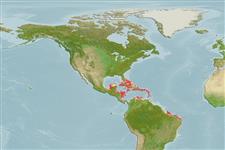
Umwelt: Milieu / Klimazone / Tiefenbereich / Verbreitungsgebiet
Ökologie
seewasser riff-verbunden; tiefenbereich 1 - 15 m (Ref. 58018). Tropical
Western Atlantic: Cuba (Ref. 26340) and the Bahamas.
Größe / Gewicht / Alter
Geschlechtsreife: Lm ? range ? - ? cm
Max length : 3.3 cm TL Männchen/unbestimmt; (Ref. 5521)
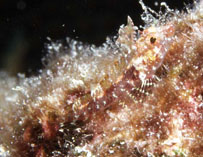
Rückenflossenstacheln (insgesamt) : 13 - 16; Rückenflossenweichstrahlen (insgesamt) : 7 - 10; Afterflossenweichstrahlen: 16. Common amongst Tripterygiids: small, slender fishes. Cirri often present on top of eye and on rim of anterior nostril. Upper and lower jaws each with broad band of conical teeth. Three well-defined dorsal fins; first with 3 spines, second with 10 to 13 spines, third with 7 to 10 segmented rays; last dorsal-fin spine and first segmented ray borne on separate pterygiophores. Caudal fin with 13 segmented rays, 9 of which are branched; pelvic fin with 2 simple segmented rays and 1 embedded spine, inserted anterior to pectoral-fin base. Ctenoid scales on body; pectoral-fin base and belly naked or covered with cycloid scales. Lateral line interrupted at midbody, anterior lateral-line scales pored, posterior scales notched. Body coloration: brown or black bars on a pale (often red) background. Species distinguished by: pectoral-fin base and belly without scales; no enlarged scales on dorsum or in pectoral-fin axil; segmented anal-fin rays usually 16; pored lateral-line scales 11 to 13 (Ref.52855).
Body shape (shape guide): elongated.
Adults inhabit patch reefs surrounded by white sand bottom (Ref. 5521). Eggs are hemispherical and covered with numerous sticky threads that anchor them in the algae on the nesting sites (Ref. 240). Larvae are planktonic which occur primarily in shallow, nearshore waters (Ref. 94114).
Lebenszyklus und Paarungsverhalten
Geschlechtsreife | Fortpflanzung | Ablaichen | Eier | Fruchtbarkeit | Larven
Böhlke, J.E. and C.C.G. Chaplin, 1993. Fishes of the Bahamas and adjacent tropical waters. 2nd edition. University of Texas Press, Austin. (Ref. 5521)
IUCN Rote Liste Status (Ref. 130435: Version 2025-2 (Global))
Bedrohung für Menschen
Harmless
Nutzung durch Menschen
Tools
Zusatzinformationen
Download XML
Internet Quellen
Schätzungen auf der Grundlage von Modellen
Bevorzugte Temperatur (Ref.
123201): 26.4 - 28.2, mean 27.5 °C (based on 593 cells).
Phylogenetischer Diversitätsindex (Ref.
82804): PD
50 = 0.5000 [Uniqueness, from 0.5 = low to 2.0 = high].
Bayesian length-weight: a=0.00617 (0.00290 - 0.01310), b=3.04 (2.86 - 3.22), in cm total length, based on LWR estimates for this (Sub)family-body shape (Ref.
93245).
Trophische Ebene (Ref.
69278): 2.8 ±0.3 se; based on size and trophs of closest relatives
Widerstandsfähigkeit (Ref.
120179): hoch, Verdopplung der Population dauert weniger als 15 Monate. (Preliminary K or Fecundity.).
Anfälligkeit der Fischerei (Ref.
59153): Low vulnerability (10 of 100).
🛈
Nährstoffe (Ref.
124155): Calcium = 628 [186, 3,535] mg/100g; Iron = 3.35 [0.92, 8.97] mg/100g; Protein = 18.1 [16.0, 20.2] %; Omega3 = 0.0949 [, ] g/100g; Selenium = 91.8 [11.6, 553.3] μg/100g; VitaminA = 25 [2, 278] μg/100g; Zinc = 7.44 [2.70, 16.19] mg/100g (wet weight);