Umwelt: Milieu / Klimazone / Tiefenbereich / Verbreitungsgebiet
Ökologie
seewasser demersal; tiefenbereich 0 - 4 m (Ref. 27742). Tropical
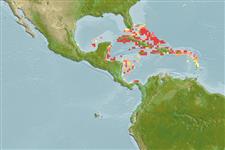
Western Central Atlantic: Bahamas and Puerto Rico.
Größe / Gewicht / Alter
Geschlechtsreife: Lm ? range ? - ? cm
Max length : 8.2 cm SL Männchen/unbestimmt; (Ref. 5521)
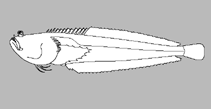
Rückenflossenstacheln (insgesamt) : 7 - 23; Afterflossenstacheln: 2. Common amongst Dactyloscopidae: Small, elongate fishes. Head usually broad and deep, body tapering and compressed behind. Eyes on top of head, often protrusible; mouth moderate to large, oblique to vertical; upper and/or lower lips with fimbriae; jaw teeth minute, in 2 or more series; no teeth on roof of mouth (vomer and palatines). Opercular opening large, gill membrane free from isthmus; opercles membranous, large, usually overlapping on underside of head, typically fringed above with 2 to 24 fleshy fimbriae. Dorsal fin continuous, with an isolated or semi-isolated anterior finlet, or with 1 to 5 separate anterior rays; dorsal-fin spines 7 to 23; anal-fin spines 2; dorsal and anal fins free or united to caudal fin by fragile membranes; pectoral fins broad-based, usually enlarged in mature males; caudal-fin rays simple or branched; pelvic fins under throat (insertion anterior to pectoral-fin base), with 1 spine and 3 thickened segmented rays; all other rays simple. Head and venter naked, body elsewhere with large cycloid scales (smooth to touch); lateral line high anteriorly, deflecting ventrally behind pectoral fin to continue along middle of side to caudal-fin base where terminal lateral-line scale bears ventrally directed canal. Body coloration, variably pale to strongly pigmented with white, brown, or reddish; some forms with characteristic saddle-like bars crossing back; others plain, mottled, or with indications of lateral stripes. Species distinguished by: dorsal-fin origin behind nape, near vertical from anal-fin origin. Lower jaw narrowly rounded in dorsal aspect, conical and strongly protruding in front (Ref.52855).
Body shape (shape guide): elongated.
Sand-dweller (Ref. 5521).
Lebenszyklus und Paarungsverhalten
Geschlechtsreife | Fortpflanzung | Ablaichen | Eier | Fruchtbarkeit | Larven
Dawson, C.E., 1982. Atlantic sand stargazers (Pisces: Dactyloscopidae), with description of one new genus and seven new species. Bull. Mar. Sci. 32(1):14-85. (Ref. 27742)
IUCN Rote Liste Status (Ref. 130435: Version 2025-2 (Global))
Bedrohung für Menschen
Harmless
Nutzung durch Menschen
Tools
Zusatzinformationen
Download XML
Internet Quellen
Schätzungen auf der Grundlage von Modellen
Bevorzugte Temperatur (Ref.
123201): 26.7 - 28, mean 27.6 °C (based on 158 cells).
Phylogenetischer Diversitätsindex (Ref.
82804): PD
50 = 0.5312 [Uniqueness, from 0.5 = low to 2.0 = high].
Bayesian length-weight: a=0.00389 (0.00180 - 0.00842), b=3.12 (2.94 - 3.30), in cm total length, based on all LWR estimates for this body shape (Ref.
93245).
Trophische Ebene (Ref.
69278): 4.7 ±0.7 se; based on size and trophs of closest relatives
Anfälligkeit der Fischerei (Ref.
59153): Low vulnerability (10 of 100).
🛈