>
Ovalentaria/misc (Various families in series Ovalentaria) >
Opistognathidae (Jawfishes)
Etymology: Opistognathus: Greek, opisthe = behind + Greek, gnathos = jaw (Ref. 45335); to the very elongate upper jaw of the type species of the genus, Opistognathus nigromarginatus (Ref. 128653).
Eponymy: Dr Carter Rowell Gilbert (1930-2022) was an American zoologist and ichthyologist. [...] (Ref. 128868), visit book page.
Environnement : milieu / zone climatique / profondeur / gamme de distribution
Écologie
marin récifal, usually 33 - ? m (Ref. 51183). Tropical
Western Central Atlantic: Bahamas, islands and reefs of the western Caribbean Sea, Jamaica, and Puerto Rico.
Taille / Poids / Âge
Maturité: Lm ? range ? - ? cm
Max length : 6.4 cm SL mâle / non sexé; (Ref. 5521)
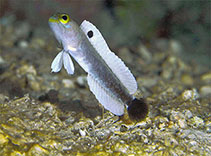
Épines dorsales (Total) : 11; Rayons mous dorsaux (Total) : 12 - 14; Épines anales: 2; Rayons mous anaux: 13 - 14. Females gray, shading to whitish ventrally on head and abdomen, with a median yellow stripe in dorsal and anal fins, and a large area of yellow in caudal fin. Males head and body reddish gray, darkening posteriorly to black, except abdomen which is whitish; caudal fin black except for a wedge-shaped white marking dorsally and ventrally at fin base; dorsal and anal fins white, the dorsal with a round black spot between fifth and sixth dorsal spines (Ref. 13442).
Body shape (shape guide): elongated.
Inhabit steep slopes at the edges of banks (Ref. 5521). Mouthbrooders (Ref. 240).
Cycle de vie et comportement reproducteur
Maturité | Reproduction | Frai | Œufs | Fécondité | Larves
Employ mouthbrooding to care for their young (Ref. 240).
Böhlke, J.E. and C.C.G. Chaplin, 1993. Fishes of the Bahamas and adjacent tropical waters. 2nd edition. University of Texas Press, Austin. (Ref. 5521)
Statut dans la liste rouge de l'IUCN (Ref. 130435: Version 2025-2 (Global))
Menace pour l'homme
Harmless
Utilisations par l'homme
Outils
Articles particuliers
Télécharger en XML
Sources Internet
Estimations basées sur des modèles
Indice de diversité phylogénétique (Réf.
82804): PD
50 = 0.5000 [Uniqueness, from 0.5 = low to 2.0 = high].
Bayesian length-weight: a=0.00389 (0.00180 - 0.00842), b=3.12 (2.94 - 3.30), in cm total length, based on all LWR estimates for this body shape (Ref.
93245).
Niveau trophique (Réf.
69278): 3.4 ±0.5 se; based on size and trophs of closest relatives
Vulnérabilité de la pêche (Ref.
59153): Low vulnerability (10 of 100).
🛈