Milieu: milieu / Klimaatzone / Diepte / verspreidingsgebied
Ecologie
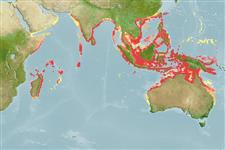
marien; zoet water; brak water pelagic-neritic; anadroom (Ref. 51243); diepte 6 - 55 m (Ref. 12260). Tropical; 25°N - 30°S, 31°E - 155°E (Ref. 54703)
Indo-West Pacific: Indian Ocean: east coast of Africa northward from about Durban (Ref. 3509) to the Gulf of Oman (Ref. 188), including Madagascar (Ref. 188, 3509), the coasts of India and Andaman Sea (Ref. 188, 6867), and south to western Australia (Ref. 188); also South China Sea (Ref. 188), and Indonesia to northern Australia and Papua New Guinea (Ref. 188, 6867).
Lengte bij maturiteit / Grootte / Gewicht / Leeftijd
Maturiteit: Lm 13.5 range ? - ? cm
Max length : 16.0 cm SL mannelijk / geslacht onbekend; (Ref. 188); common length : 13.0 cm SL mannelijk / geslacht onbekend; (Ref. 2871)
Korte beschrijving
Determinatiesleutels | Morfologie | Morfometrie
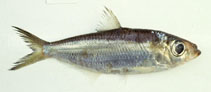
Dorsale stekels (totaal) : 0; Dorsale zachte stralen (totaal) : 16 - 19; Anale stekels: 0; Anale zachte stralen: 34 - 42. Diagnosis: Body moderately deep, compressed, belly with strongly keeled scutes, 17-20 pre-pelvic and 8-10 post-pelvic scutes, with a total of total 25-29 scutes (Ref. 188, 6867). Eye large; lower jaw projecting; upper jaw with a toothed hypomaxillary bone between hind tip of pre-maxilla and lower bulge of maxilla blade; lower gillrakers 22-27; dorsal fin origin near midpoint of body; pelvic fins present; anal fin with 34-42 finrays; scales with upper and lower vertical striae slightly overlapping each other at centre of scales (Ref. 188). It closely resembles Pellona dayi, which has only 20-21 lower gillrakers and the vertical scale striae not meeting at centre of scale; species of Ilisha have no hypomaxilla; other pristigasterids are much more slender and lack pelvic fins (Ref. 188).
Body shape (shape guide): fusiform / normal; Cross section: compressed.
A pelagic species found in coastal areas (Ref. 2871, 6867) at depths from 6 to 36 meters (Ref. 3225); occasionally entering mangrove swamps and penetrating estuaries into freshwater (Ref. 188, 3509, 54703). Apparently fully euryhaline (Ref. 188). Marketed fresh and may be dried or salted (Ref. 5284). Regarded as an excellent bait in the tuna fishery.
Levenscyclus en paargedrag
Maturiteit | Voortplanting | Paaien | Eieren | Fecunditeit | Larven
Whitehead, P.J.P., 1985. FAO Species Catalogue. Vol. 7. Clupeoid fishes of the world (suborder Clupeoidei). An annotated and illustrated catalogue of the herrings, sardines, pilchards, sprats, shads, anchovies and wolf-herrings. FAO Fish. Synop. 125(7/1):1-303. Rome: FAO. (Ref. 188)
Status op de Rode Lijst van het IUCN (Ref. 130435: Version 2025-2 (Global))
Gevaar voor de mens
Harmless
Gebruik door de mens
Visserij: commercieel; aas: usually
Tools
Speciale rapporten
Download XML
Internetbronnen
Schattingen op basis van modellen
Gewenste temperatuur (Ref.
123201): 26.4 - 29.1, mean 28.3 °C (based on 884 cells).
Fylogenetische diversiteitsindex (Ref.
82804): PD
50 = 0.5156 [Uniqueness, from 0.5 = low to 2.0 = high].
Bayesian length-weight: a=0.00692 (0.00437 - 0.01096), b=3.10 (2.97 - 3.23), in cm total length, based on LWR estimates for this species & (Sub)family-body (Ref.
93245).
Trofisch niveau (Ref.
69278): 4.0 ±0.7 se; based on size and trophs of closest relatives
Weerstandsvermogen (Ref.
120179): Hoog, minimale populatieverdubbelingstijd minder dan 15 maanden (K=0.28-0.74).
Kwetsbaarheid van de visserij (Ref.
59153): Low vulnerability (21 of 100).
🛈
Kwetsbaarheid voor het klimaat (Ref.
125649): Moderate to high vulnerability (52 of 100).
🛈
Voedingsstoffen (Ref.
124155): Calcium = 251 [131, 510] mg/100g; Iron = 1.98 [1.19, 3.22] mg/100g; Protein = 19.1 [17.7, 20.5] %; Omega3 = 0.45 [0.23, 0.83] g/100g; Selenium = 36.6 [18.5, 72.6] μg/100g; VitaminA = 37.3 [15.0, 89.1] μg/100g; Zinc = 1.81 [1.25, 2.52] mg/100g (wet weight);