>
Blenniiformes (Blennies) >
Blenniidae (Combtooth blennies) > Salariinae
Etymology: Hypleurochilus: Greek, hypo = under + Greek, pleura = in the side of + Greek, cheilos = lip.
More on author: Poll.
Ambiente: milieu / zona climatica / distribuzione batimetrica / gamma di distribuzione
Ecologia
marino demersale; distribuzione batimetrica 0 - 30 m (Ref. 97251), usually 0 - 5 m (Ref. 97251). Subtropical
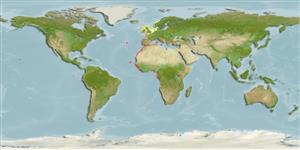
Eastern Central Atlantic: Moanda-Tonde and Crique de Banana, Congo. Mediterranean Sea: Off Naples, Palermo, Alger and coast of Israel.
Dimensione / Peso / Età
Maturità: Lm ? range ? - ? cm
Max length : 12.0 cm TL maschio/sesso non determinato; (Ref. 97251)
Breve descrizione
Chiavi di identificazione | Morfologia | Morfometria
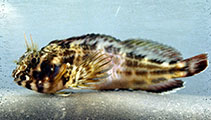
Diagnosed by having the following characteristics: brown-yellowish body color with five irregular vertical dark bars extending to the lower part of the dorsal fin; remaining part of fin same as body color; head may have some bluish tinge; thick superior upper lip; mark V-like cavity between the eyes; wrinkled dorsal area between the head and the beginning of dorsal fin; caudal fin with a series of alternating light and dark vertical bars; cirri with several branches, grouped in a common base; most developed branch lies at the centre and surrounded by several thinner and shorter branches (Ref. 97253).
Body shape (shape guide): fusiform / normal.
Adults occur in shallow waters near harbors and on rocky shores of coastal waters (Ref. 5298, 5981). Oviparous. Males are extremely territorial especially when guarding eggs (Ref. 97521). Eggs are demersal and adhesive (Ref. 205), and are attached to the substrate via a filamentous, adhesive pad or pedestal (Ref. 94114). Larvae are planktonic, often found in shallow, coastal waters (Ref. 94114).
Ciclo vitale e comportamento di accoppiamento
Maturità | Riproduzione | Deposizione | Uova | Fecondità | Larve
Oviparous, distinct pairing (Ref. 205).
Bath, H., 1990. Blenniidae. p. 905-915. In J.C. Quero, J.C. Hureau, C. Karrer, A. Post and L. Saldanha (eds.) Check-list of the fishes of the eastern tropical Atlantic (CLOFETA). JNICT, Lisbon; SEI, Paris; and UNESCO, Paris. Vol. 2. (Ref. 5298)
Stato della Lista Rossa IUCN (Ref. 130435: Version 2025-2 (Global))
Minaccia per l'uomo
Harmless
Usi umani
Strumenti
Rapporti speciali
Scarica XML
Fonti Internet
Stime basate su modelli
Temperatura preferita (Fonte Biblio.
123201): 16 - 27.9, mean 20 °C (based on 593 cells).
Indice di diversità filogenetica (Fonte Biblio.
82804): PD
50 = 0.5005 [Uniqueness, from 0.5 = low to 2.0 = high].
Bayesian length-weight: a=0.01047 (0.00463 - 0.02370), b=2.98 (2.79 - 3.17), in cm total length, based on LWR estimates for this (Sub)family-body shape (Ref.
93245).
Livello trofico (Fonte Biblio.
69278): 3.2 ±0.3 se; based on size and trophs of closest relatives
Resilienza (Fonte Biblio.
120179): Alto, tempo minimo di raddoppiamento della popolazione meno di 15 mesi (Preliminary K or Fecundity.).
Vulnerabilità della pesca (Ref.
59153): Low vulnerability (10 of 100).
🛈