>
Clupeiformes (Herrings) >
Dorosomatidae (Gizzard shads and sardinellas)
Etymology: Gonialosa: Greek, gonio = angle + Latin, alausa = a fish cited by Ausonius and Latin, halec = pickle, dealing with the Greek word hals = salt; it is also the old Saxon name for shad = "alli" ; 1591 (Ref. 45335).
More on author: Hamilton.
Milieu: milieu / Klimaatzone / Diepte / verspreidingsgebied
Ecologie
; zoet water; brak water pelagisch; amfidroom (Ref. 51243). Tropical; 29°N - 21°N
Asia: rivers and associated water bodies of Sri Lanka, India (Ganges and other rivers of Orissa, Uttar Pradesh, Bengal, Assam), and Bangladesh. (The Andaman record is doubtful - perhaps Anodontostoma selangkat).
Grootte / Gewicht / Leeftijd
Maturiteit: Lm ? range ? - ? cm
Max length : 14.9 cm TL mannelijk / geslacht onbekend; (Ref. 126021); max. gepubliceerd gewicht: 37.71 g (Ref. 126021)
Korte beschrijving
Determinatiesleutels | Morfologie | Morfometrie
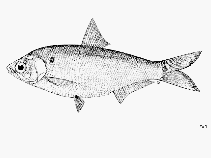
Dorsale stekels (totaal) : 0; Anale stekels: 0; Anale zachte stralen: 22 - 28. Body fairly deep, somewhat compressed, belly with 16 to 20 (usually 17 or 18) + 11 to 14 (usually 11 to 13), total 27 to 33 (usually 29 to 31) scutes. Upper jaw slender at tip and distinctly turned down, second supra-maxilla very small. Gill rakers fine and numerous (90 to 180 on lower arch). Pre-dorsal scales paired and overlapping in midline; scales moderate or small.
Body shape (shape guide): fusiform / normal; Cross section: compressed.
Found in rivers and pools. More data needed.
Levenscyclus en paargedrag
Maturiteit | Voortplanting | Paaien | Eieren | Fecunditeit | Larven
Whitehead, P.J.P., 1985. FAO Species Catalogue. Vol. 7. Clupeoid fishes of the world (suborder Clupeoidei). An annotated and illustrated catalogue of the herrings, sardines, pilchards, sprats, shads, anchovies and wolf-herrings. FAO Fish. Synop. 125(7/1):1-303. Rome: FAO. (Ref. 188)
Status op de Rode Lijst van het IUCN (Ref. 130435: Version 2025-2 (Global))
Gevaar voor de mens
Harmless
Gebruik door de mens
Visserij: visserij voor eigen gebruik
Tools
Speciale rapporten
Download XML
Internetbronnen
Schattingen op basis van modellen
Fylogenetische diversiteitsindex (Ref.
82804): PD
50 = 0.6250 [Uniqueness, from 0.5 = low to 2.0 = high].
Bayesian length-weight: a=0.00832 (0.00516 - 0.01342), b=3.03 (2.89 - 3.17), in cm total length, based on LWR estimates for this species & (Sub)family-body (Ref.
93245).
Trofisch niveau (Ref.
69278): 3.1 ±0.3 se; based on size and trophs of closest relatives
Weerstandsvermogen (Ref.
120179): Hoog, minimale populatieverdubbelingstijd minder dan 15 maanden (Preliminary K or Fecundity.).
Kwetsbaarheid van de visserij (Ref.
59153): Low vulnerability (10 of 100).
🛈
Voedingsstoffen (Ref.
124155): Calcium = 96 [30, 517] mg/100g; Iron = 1.07 [0.45, 3.54] mg/100g; Protein = 18.1 [16.2, 20.2] %; Omega3 = 0.463 [0.252, 0.840] g/100g; Selenium = 37.6 [18.7, 75.8] μg/100g; VitaminA = 47.4 [20.7, 110.5] μg/100g; Zinc = 2.03 [1.42, 2.95] mg/100g (wet weight); based on
nutrient studies.