>
Cypriniformes (Carps) >
Cyprinidae (Minnows or carps) > Cyprininae
Etymology: Puntioplites: Latin, punctum = point, the point of the sword + Greek, hoplon = weapon (Ref. 45335).
More on author: Bleeker.
Taxonomic Remarks
Spelling of specific epithet to check with ECoF.
Environnement : milieu / zone climatique / profondeur / gamme de distribution
Écologie
; eau douce benthopélagique; potamodrome (Ref. 51243). Tropical
Asia: Maeklong, Chao Phraya and Mekong basins and Malay Peninsula.
Taille / Poids / Âge
Maturité: Lm ? range ? - ? cm
Max length : 44.0 cm TL mâle / non sexé; (Ref. 118477)
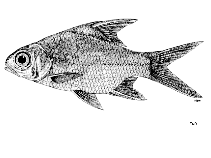
Body color brownish with reticulated dark scale edges; 17-22 dorsal spine serrations; serrated anal spine; very dark median fins, never orange (Ref. 12693). Last simple dorsal ray not reaching caudal fin in adults; dark grey anal, caudal and dorsal fins (Ref. 43281). Origin of pelvic fin opposite to origin of dorsal fin; lateral line decurved and extending to middle of caudal peduncle (Ref. 45563).
Body shape (shape guide): fusiform / normal.
Inhabits large, slow flowing rivers (Ref. 43281). Commonly found in standing and slowly moving water of streams, canal, ditches and reservoirs. Moves into flooded forests and marshes during high water periods. Usually occurs around submerged aquatic or inundated terrestrial vegetation where it consumes some algae but mostly insects and zooplankton. Larger fish are marketed fresh while smaller ones are used to make prahoc along the Tonlé Sap, Cambodia (Ref. 12693). Reaches more than 30 cm in length (Ref. 4792).
Cycle de vie et comportement reproducteur
Maturité | Reproduction | Frai | Œufs | Fécondité | Larves
Rainboth, W.J., 1996. Fishes of the Cambodian Mekong. FAO species identification field guide for fishery purposes. FAO, Rome, 265 p. (Ref. 12693)
Statut dans la liste rouge de l'IUCN (Ref. 130435: Version 2025-2 (Global))
Menace pour l'homme
Harmless
Utilisations par l'homme
Pêcheries: commercial
Outils
Articles particuliers
Télécharger en XML
Sources Internet
Estimations basées sur des modèles
Indice de diversité phylogénétique (Réf.
82804): PD
50 = 0.5625 [Uniqueness, from 0.5 = low to 2.0 = high].
Bayesian length-weight: a=0.01072 (0.00658 - 0.01745), b=3.04 (2.90 - 3.18), in cm total length, based on LWR estimates for this species & (Sub)family-body (Ref.
93245).
Niveau trophique (Réf.
69278): 2.7 ±0.28 se; based on food items.
Résilience (Réf.
120179): Milieu, temps minimum de doublement de population : 1,4 à 4,4 années (Preliminary K or Fecundity.).
Vulnérabilité de la pêche (Ref.
59153): Low to moderate vulnerability (34 of 100).
🛈
Nutriments (Ref.
124155): Calcium = 262 [124, 874] mg/100g; Iron = 1.39 [0.56, 3.42] mg/100g; Protein = 17.4 [16.7, 18.1] %; Omega3 = 0.516 [0.229, 1.181] g/100g; Selenium = 64.6 [29.3, 141.4] μg/100g; VitaminA = 71.7 [34.5, 141.6] μg/100g; Zinc = 1.79 [0.98, 3.65] mg/100g (wet weight); based on
nutrient studies.