>
Siluriformes (Catfishes) >
Bagridae (Bagrid catfishes)
Etymology: Hemibagrus: Greek, hemi = the half + Mozarabic, bagre, Greek, pagros = a fish, Dentex sp. (Ref. 45335).
Eponymy: Dr Herman Constantijn Van der Wijck (1815–1889) was Regent of the Preanger Regencies, Java, Indonesia (which is the type locality) and invited Bleeker to a fishing party during which the river was poisoned with ‘akar toeba’ (the roots of which plant [...] (Ref. 128868), visit book page.
More on author: Bleeker.
Environnement : milieu / zone climatique / profondeur / gamme de distribution
Écologie
; eau douce démersal; potamodrome (Ref. 51243). Tropical; 22°C - 25°C (Ref. 2059)
Asia: Thailand to Indonesia.
Taille / Poids / Âge
Maturité: Lm ? range ? - ? cm
Max length : 90.0 cm TL mâle / non sexé; (Ref. 130031)
Description synthétique
Clés d'identification | Morphologie | Morphométrie
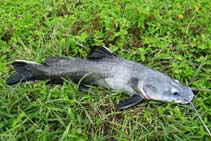
Épines dorsales (Total) : 1; Rayons mous dorsaux (Total) : 7; Rayons mous anaux: 10 - 13; Vertèbres: 50 - 51. Can be differentiated from its congeners by the unique combination of the following characters: head extremely depressed and broad; dorsal spine well ossified, long (11.9-14.8% SL), and with 10-12 serrations on the posterior edge; cream-colored coracoidal region; caudal fin dark grey, with cream procurrent and first principal caudal rays; maxillary barbels reaching to middle of dorsal-fin base (143.7-195.4% HL) (Ref. 38441). Smooth flat skull roof; occipital process reaches basal bone of dorsal fin; 10-11 soft pectoral-fin rays; no stripe on body (Ref. 12693). Presence of white markings on pectoral fin and dorsal fin tips, anterior edge of adipose, upper and lower margins of caudal peduncle and caudal, including filaments (Ref. 43281).
Body shape (shape guide): elongated.
Lives in large rivers with fast flowing water over muddy substrate (Ref. 56749). Appears to be restricted in the middle reaches of rivers (Ref. 40801). Feeds on insects, prawns and fishes. Sold fresh in the markets (Ref. 33813).
Cycle de vie et comportement reproducteur
Maturité | Reproduction | Frai | Œufs | Fécondité | Larves
Ng, H.H. and W.J. Rainboth, 1999. The bagrid catfish genus Hemibagrus (Teleostei: Siluriformes) in central Indochina with a new species from the Mekong River. Raffles Bull. Zool. 47(2):555-576. (Ref. 38441)
Statut dans la liste rouge de l'IUCN (Ref. 130435: Version 2025-2 (Global))
Menace pour l'homme
Harmless
Utilisations par l'homme
Pêcheries: commercial
Outils
Articles particuliers
Télécharger en XML
Sources Internet
Estimations basées sur des modèles
Indice de diversité phylogénétique (Réf.
82804): PD
50 = 0.5000 [Uniqueness, from 0.5 = low to 2.0 = high].
Bayesian length-weight: a=0.00776 (0.00444 - 0.01358), b=2.92 (2.77 - 3.07), in cm total length, based on LWR estimates for this species & (Sub)family-body (Ref.
93245).
Niveau trophique (Réf.
69278): 3.8 ±0.61 se; based on food items.
Résilience (Réf.
120179): Milieu, temps minimum de doublement de population : 1,4 à 4,4 années (Fec = 8,000).
Vulnérabilité de la pêche (Ref.
59153): High vulnerability (56 of 100).
🛈