>
Clupeiformes (Herrings) >
Dorosomatidae (Gizzard shads and sardinellas)
Etymology: Dorosoma: Greek, doris = lance + Greek, soma = body (Ref. 45335).
Eponymy: Dr Hugh McCormick Smith (1865–1941) was an American physician (1888) who became an ichthyologist. [...] (Ref. 128868), visit book page.
More on authors: Hubbs & Miller.
Entorno: milieu / zona climática / rango de profundidad / gama de distribución
Ecología
; agua dulce pelágico. Subtropical; 29°N - 20°N
North America: Pacific drainage of northwestern Mexico (Río Piaxtla, Río del Fuerte, Río Sinaloa system, Río de Mocorito, Río Muerto, Río Yaqui system, i.e. between Sinaloa and Sonora).
Tamaño / Peso / Edad
Madurez: Lm ? range ? - ? cm
Max length : 14.0 cm SL macho / no sexado; (Ref. 188)
Descripción breve
Claves de identificación | Morfología | Morfometría
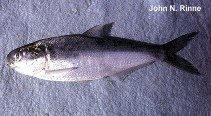
Espinas dorsales (total) : 0; Espinas anales: 0; Radios blandos anales: 22 - 29. Body moderately deep; belly with 15 to 18 + 9 to 12 scutes. Mouth small. Last dorsal fin ray long, but less the distance from snout tip to pelvic fin base; anal fin relatively short. Scales somewhat small, somewhat irregular. A dark spot behind gill opening. Distinguished from Opisthonema species by its anal fin which is longer than head and well behind dorsal fin base.
Body shape (shape guide): fusiform / normal; Cross section: compressed.
Occurs in rivers and perhaps in lakes. A filter-feeder, its feeding and breeding habits presumably similar to other Dorosoma species. More data needed.
Ciclo vital y comportamiento de apareamiento
Madurez | Reproducción | Puesta | Huevos | Fecundidad | Larva
Whitehead, P.J.P., 1985. FAO Species Catalogue. Vol. 7. Clupeoid fishes of the world (suborder Clupeoidei). An annotated and illustrated catalogue of the herrings, sardines, pilchards, sprats, shads, anchovies and wolf-herrings. FAO Fish. Synop. 125(7/1):1-303. Rome: FAO. (Ref. 188)
Situación en la Lista Roja de la UICN (Ref. 130435: Version 2025-2 (Global))
Amenaza para el ser humano
Harmless
Usos humanos
Pesquerías: pesquerías de subsistencia
Herramientas
Informes especiales
Descargar XML
Fuentes de Internet
Estimaciones basadas en modelos
Índice de diversidad filogenética (Referencia
82804): PD
50 = 0.5312 [Uniqueness, from 0.5 = low to 2.0 = high].
Bayesian length-weight: a=0.00871 (0.00414 - 0.01834), b=3.06 (2.89 - 3.23), in cm total length, based on LWR estimates for this (Sub)family-body shape (Ref.
93245).
Nivel trófico (Referencia
69278): 3.4 ±0.45 se; based on food items.
Resiliencia (Referencia
120179): Alto, población duplicada en un tiempo mínimo inferior a 15 meses (Preliminary K or Fecundity.).
Vulnerabilidad pesquera (Ref.
59153): Low vulnerability (10 of 100).
🛈