Окружающая среда: среда / климатическая зона / пределы глубины / диапазон распространения
экология
морской; солоноватоводный ассоциированный с рифами; пределы глубины 0 - 100 m (Ref. 9710), usually ? - 46 m (Ref. 55295). Subtropical; 36°N - 33°S, 121°W - 12°E (Ref. 55295)
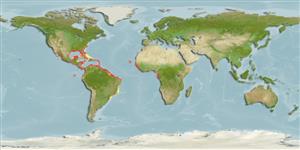
Western Atlantic: Florida, USA to southern Brazil, including the Gulf of Mexico and the Caribbean. Eastern Atlantic: Senegal to Congo (reported as Epinephelus esonue, Ref. 2739, 6809); rare in Canary Islands (Ref. 6808). Eastern Pacific (Gulf of California to Peru) species refers to Epinephelus quinquefasciatus. Discrete populations of E. itajara exist in the western Atlantic (Ref. 89627).
Длина при первой зрелости / Размер / Вес / Возраст
половая зрелость: Lm 128.0 range ? - ? cm
Max length : 250 cm TL самец/пол неопределен; (Ref. 26550); common length : 150 cm TL самец/пол неопределен; (Ref. 5217); наибольший вес (опубликованные данные): 455.0 kg (Ref. 4841); наибольший возраст (опубликованны данные): 37 годы (Ref. 4841)
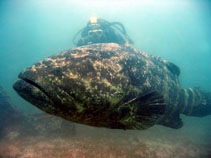
колючие лучи спинного плавника (общее число) : 11; членистые (мягкие) лучи спинного плавника (общее число) : 15 - 16; колючие лучи анального плавника: 3; членистые (мягкие) лучи анального плавника: 8. Distinguished by the following characteristics: brownish yellow, grey or greenish body color; head and dorsal part of body and fins with small black spots; body robust and elongate; body depth contained 2.7-3.4 times in SL; HL 2.3-2.9 in SL; extremely broad head; flat interorbital; rounded preopercle, finely serrate; round nostrils, subequal; maxilla scaly, reaching well past eye; 3-5 rows of subequal teeth on midlateral part of lower jaw; absence of canines at front jaw (Ref. 89707); further characterized by having opercle with 3 flat spines, middle one the largest. Pelvic fins smaller than the pectorals. Bases of soft dorsal and anal fins covered with scales and thick skin. Juveniles tawny with irregular vertical bands.
Body shape (shape guide): fusiform / normal; Cross section: compressed.
A solitary species (Ref. 26340) occurring in shallow, inshore areas. Found on rock, coral, or mud bottoms (Ref. 5217). Juveniles found in mangrove areas and brackish estuaries (Ref. 5217). Large adults may be found in estuaries (Ref. 5217). Adults appear to occupy limited home ranges with little inter-reef movement. Feeds primarily on crustaceans, particularly spiny lobsters as well as turtles and fishes, including stingrays. Territorial near its refuge cave or wreck where it may show a threat display with open mouth and quivering body. Larger individuals have been known to stalk and attacks divers. Over-fished, primarily by spear fishing (Ref. 9710). Marketed fresh and salted. Meat is of excellent quality. Important game fish (Ref. 9342). Reported to reach weights of more than 315 kg (Ref. 26938).
Heemstra, P.C. and J.E. Randall, 1993. FAO Species Catalogue. Vol. 16. Groupers of the world (family Serranidae, subfamily Epinephelinae). An annotated and illustrated catalogue of the grouper, rockcod, hind, coral grouper and lyretail species known to date. Rome: FAO. FAO Fish. Synop. 125(16):382 p. (Ref. 5222)
Статус Красного Списка МСОП (Ref. 130435: Version 2025-2 (Global))
Угроза для людей
Traumatogenic (Ref. 4716)
Использование человеком
рыболовство: не имеет хозяйственного значения; объект спортивного рыболовства: да
дополнительная информация
инструменты
Специальные отчеты
Скачать в формате XML
ресурсы в Интернет
Оценки, основанные на моделях
Предпочтительная температура (ссылка
123201): 22.8 - 28, mean 26.3 °C (based on 532 cells).
Индекс филогенетического разнообразия (ссылка
82804): PD
50 = 0.5000 [Uniqueness, from 0.5 = low to 2.0 = high].
Bayesian length-weight: a=0.01072 (0.00626 - 0.01833), b=3.04 (2.90 - 3.18), in cm total length, based on LWR estimates for this species & Genus-body shape (Ref.
93245).
Трофический уровень (ссылка
69278): 4.1 ±0.0 se; based on diet studies.
Generation time: 8.7 ( na - na) years. Estimated as median ln(3)/K based on 1
growth studies.
устойчивость к внешним воздействиям (ссылка
120179): низкий, минимальное время удвоения популяции 4.5-14 лет (K=0.13; tm=5.5-6.5).
Уязвимость рыбной ловли (Ref.
59153): High to very high vulnerability (70 of 100).
🛈
Питательные вещества (Ref.
124155): Calcium = 7.75 [2.67, 16.99] mg/100g; Iron = 0.365 [0.171, 0.783] mg/100g; Protein = 19.9 [18.3, 21.5] %; Omega3 = 0.169 [0.084, 0.334] g/100g; Selenium = 25.9 [11.7, 60.3] μg/100g; VitaminA = 40.7 [8.5, 195.4] μg/100g; Zinc = 0.626 [0.390, 0.977] mg/100g (wet weight);