>
Clupeiformes (Herrings) >
Dorosomatidae (Gizzard shads and sardinellas)
Etymology: Tenualosa: Latin, tenuis = thin + Latin, alausa = a fish cited by Ausonius and Latin, halec = pickle, dealing with the Greek word hals = salt; it is also the old Saxon name for shad = "alli" ; 1591 (Ref. 45335).
Eponymy: John Reeves (1774–1856) was an English amateur naturalist and collector who served in China, chiefly Canton and Macao, as a civil servant (1812–1831). [...] (Ref. 128868), visit book page.
More on author: Richardson.
Lingkungan: lingkungan / zona iklim / kisaran kedalaman / jangkauan distribusi
Ekologi
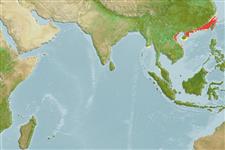
laut; air tawar; payau pelagic-neritic; anadromus (ruaya dari laut ke air tawar) (Ref. 51243); kisaran kedalaman 0 - 50 m (Ref. 188). Tropical; 31°N - 5°N, 95°E - 123°E (Ref. 188)
Northwest Pacific: China and possibly southward into South China Sea, but records uncertain. Eastern Indian Ocean: two specimens collected from Phuket Island, Andaman Sea. The species thus overlaps Tenualosa toli in range.
Panjang pada saat jatuh tempo pertama / Ukuran / Berat / umur
Kematangan: Lm 47.5, range 44 - 51 cm
Max length : 61.6 cm TL jantan/; (Ref. 45563); common length : 40.0 cm TL jantan/; (Ref. 27773); Berat maksimum terpublikasi: 5.0 kg (Ref. 47439); Umur maksimum dilaporkan: 8 Tahun (Ref. 45563)
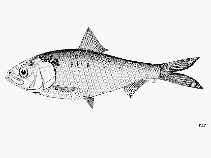
Duri punggung (Keseluruhan (total)) : 3; duri punggung lunak (Keseluruhan (total)) : 14 - 15; Duri dubur: 2; Sirip dubur lunak: 16 - 18; vertebrata, bertulang belakang: 44 - 45. Belly with 29 to 34 scutes. Head large; a median notch in upper jaw, which distinguishes it from other similar clupeids, except Hilsa kelee; with a well developed sebaceous eyelids. Gill rakers fine and numerous, each raker with scattered asperities. Caudal fin deeply forked with minute scales. A dark blotch behind gill opening and a series of spots along flank. Color: Metallic blue-green back that lightens to silver along the sides (Ref. 45563).
Body shape (shape guide): fusiform / normal; Cross section: compressed.
Schooling in coastal waters and ascending rivers to breed. Adults are found near the surface at sea while larvae and juveniles spend the first two years of their life in river tide pools and estuaries (Ref. 57990). Feed on planktonic crustaceans like cyclopoids and other copepods, and rotifers (Ref. 45563).
Ascend rivers to breed (Ref. 45563). After spawning, the adults go back to the sea while the larvae stay in river mouths during their first year. At the beginning of their second year, the juveniles swim to the sea (Ref. 45563).
Whitehead, P.J.P., 1985. FAO Species Catalogue. Vol. 7. Clupeoid fishes of the world (suborder Clupeoidei). An annotated and illustrated catalogue of the herrings, sardines, pilchards, sprats, shads, anchovies and wolf-herrings. FAO Fish. Synop. 125(7/1):1-303. Rome: FAO. (Ref. 188)
Status IUCN Red List (Ref. 130435: Version 2025-2 (Global))
ancaman kepada manusia
Harmless
penggunaan manusia
Perikanan: nilai komersial kecil
Alat, peralatan
laporan khas
muat turun XML
Sumber internet
Estimasi berdasarkan model
Suhu yang disukai (Acuan
123201): 22.8 - 26.6, mean 25.2 °C (based on 90 cells).
Indeks keanekaragaman filogenetik (Acuan
82804): PD
50 = 0.5312 [Uniqueness, from 0.5 = low to 2.0 = high].
Bayesian length-weight: a=0.01072 (0.00661 - 0.01737), b=3.05 (2.91 - 3.19), in cm total length, based on LWR estimates for this species & (Sub)family-body (Ref.
93245).
Tingkat Trofik (Acuan
69278): 3.2 ±0.29 se; based on food items.
Generation time: 3.8 ( na - na) years. Estimated as median ln(3)/K based on 2
growth studies.
Daya lenting (Acuan
120179): sedang, Waktu penggandaan populasi minimum 1.4 - 4.4 tahun (tm=3; tmax=8; K=0.25-0.29; Fec = 1,070,000).
Kerentanan Penangkapan Ikan (Ref.
59153): Low to moderate vulnerability (34 of 100).
🛈