>
Clupeiformes (Herrings) >
Dorosomatidae (Gizzard shads and sardinellas)
Etymology: Hilsa: Bangladesh and Bengali local name for a fish.
More on author: Cuvier.
Milieu: milieu / Klimaatzone / Diepte / verspreidingsgebied
Ecologie
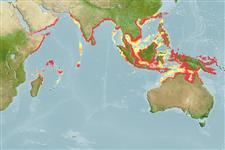
marien; zoet water; brak water pelagic-neritic; anadroom (Ref. 51243); diepte 10 - ? m (Ref. 30573). Tropical; 25°N - 18°S, 43°E - 155°E (Ref. 54554)
Indo-West Pacific: probably all coasts of Indian Ocean, from Gulf of Oman and Gulf of Aden south to Durban and Madagascar, across the Bay of Bengal, Gulf of Thailand, Java Sea and north to Hong Kong and east to Papua New Guinea and possibly further (Ref. 188).
Lengte bij maturiteit / Grootte / Gewicht / Leeftijd
Maturiteit: Lm 15.0 range ? - ? cm
Max length : 35.0 cm TL mannelijk / geslacht onbekend; (Ref. 11228); common length : 16.5 cm SL mannelijk / geslacht onbekend; (Ref. 188)
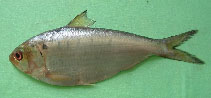
Dorsale stekels (totaal) : 0; Dorsale zachte stralen (totaal) : 16 - 19; Anale stekels: 0; Anale zachte stralen: 17 - 23. Diagnosis: Body fairly deep and compressed, belly with distinct keel of scutes; top of head with numerous fronto-parietal striae; upper jaw with median notch; gillrakers about 100 to 175, those on inner arches distinctly curled; outer row of gill filaments on first arch not more than half length of gillrakers; a series of small triangular scales above axil of pectoral fin; hind part of body scales perforated (Ref. 188). A black spot behind gill cover, usually followed by up to 10 spots along flank (Ref. 188).
Body shape (shape guide): fusiform / normal; Cross section: compressed.
Found in coastal waters (Ref. 3107, 30573); marine, pelagic, but entering estuaries and able to tolerate quite low salinities (7 ppt) (Ref. 188). Feeds chiefly on phytoplankton, mainly diatoms, also dinoflagellates, but also copepods, molluscan and crustacean larvae, prawns, amphipods and polychaetes (Ref. 188). Spawns, at least in Godavari estuary, around February (Ref. 188). Marketed fresh, dried, dried-salted and boiled. Made into fish balls.
Whitehead, P.J.P., 1985. FAO Species Catalogue. Vol. 7. Clupeoid fishes of the world (suborder Clupeoidei). An annotated and illustrated catalogue of the herrings, sardines, pilchards, sprats, shads, anchovies and wolf-herrings. FAO Fish. Synop. 125(7/1):1-303. Rome: FAO. (Ref. 188)
Status op de Rode Lijst van het IUCN (Ref. 130435: Version 2025-2 (Global))
Gevaar voor de mens
Harmless
Gebruik door de mens
Visserij: van groot commercieel belang; aas: occasionally
Tools
Speciale rapporten
Download XML
Internetbronnen
Schattingen op basis van modellen
Gewenste temperatuur (Ref.
123201): 25.8 - 29.1, mean 28.3 °C (based on 772 cells).
Fylogenetische diversiteitsindex (Ref.
82804): PD
50 = 1.0000 [Uniqueness, from 0.5 = low to 2.0 = high].
Bayesian length-weight: a=0.01000 (0.00625 - 0.01599), b=3.03 (2.89 - 3.17), in cm total length, based on LWR estimates for this species & (Sub)family-body (Ref.
93245).
Trofisch niveau (Ref.
69278): 2.9 ±0.33 se; based on food items.
Generation time: 1.0 ( na - na) years. Estimated as median ln(3)/K based on 1
growth studies.
Weerstandsvermogen (Ref.
120179): Hoog, minimale populatieverdubbelingstijd minder dan 15 maanden (K=1.1).
Kwetsbaarheid van de visserij (Ref.
59153): Low vulnerability (18 of 100).
🛈
Kwetsbaarheid voor het klimaat (Ref.
125649): High to very high vulnerability (71 of 100).
🛈
Voedingsstoffen (Ref.
124155): Calcium = 204 [116, 375] mg/100g; Iron = 2.01 [1.12, 3.29] mg/100g; Protein = 19.2 [18.1, 20.2] %; Omega3 = 0.411 [0.231, 0.728] g/100g; Selenium = 61.5 [30.1, 125.8] μg/100g; VitaminA = 9.95 [4.03, 23.19] μg/100g; Zinc = 1.78 [1.25, 2.60] mg/100g (wet weight);