>
Clupeiformes (Herrings) >
Alosidae (Shads and Sardines)
Etymology: Alosa: Latin, alausa = a fish cited by Ausonius and Latin, halec = pickle, dealing with the Greek word hals = salt; it is also the old Saxon name for shad = "alli" ; 1591 (Ref. 45335); sapidissima: sapidissima meaning most delicious (Ref. 1998).
Milieu: milieu / Klimaatzone / Diepte / verspreidingsgebied
Ecologie
marien; zoet water; brak water pelagic-neritic; anadroom (Ref. 138280); diepte 0 - 250 m (Ref. 6793). Subtropical; 54°N - 28°N, 84°W - 52°W (Ref. 86798)
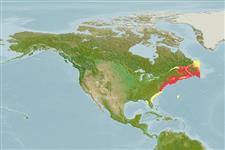
North America: Atlantic coast from Labrador, Canada to St. Johns River, Florida, USA; ascends coastal rivers during spring spawning migrations. Introduced into Sacramento River, California in 1870s and has spread along Pacific Coast from Kamchatka, Russia to Todos Santos Bay, Mexico. Landlocked in Millerton Lake, California, USA.
Lengte bij maturiteit / Grootte / Gewicht / Leeftijd
Maturiteit: Lm 43.4, range 38 - 48.5 cm
Max length : 76.0 cm TL mannelijk / geslacht onbekend; (Ref. 6885); 61.7 cm SL (female); common length : 50.0 cm SL mannelijk / geslacht onbekend; (Ref. 188); max. gepubliceerd gewicht: 5.5 kg (Ref. 7251); max. gerapporteerde leeftijd: 13 Jaren (Ref. 72462)
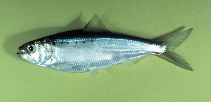
Dorsale stekels (totaal) : 0; Dorsale zachte stralen (totaal) : 15 - 19; Anale stekels: 0; Anale zachte stralen: 18 - 24; Wervels: 51 - 60. Moderately compressed, belly with a distinct keel. Lower jaw not rising steeply within mouth. Gill rakers long and slender (fewer in young). Silvery in color with blue or blue-green metallic luster on back (Ref. 1998). A dark spot on shoulder, sometimes followed by several more, or even a second row. Resembles A. pseudoharengus with lower jaw rising steeply within mouth, eyes larger, and fewer lower gill rakers, as also A. aestivalis and A. mediocris (Ref. 188). Silvery, with a green or bluish back (Ref. 7251). Branchiostegal rays 7 (Ref. 4639).
Body shape (shape guide): fusiform / normal; Cross section: compressed.
Adults spend most of their life at sea, returning to freshwater streams to breed (Ref. 27547). They inhabit open water of large rivers (Ref. 86798). Non-spawning adults are found in schools near the surface of continental shelf waters in spring, summer and fall (Ref. 7135); also found in brackish waters (Ref. 4607). Newly hatched larvae are found in rivers during the summer; by autumn they enter the sea and remain there until maturity. Juveniles form schools at 20-30 mm TL and gradually move downstream (Ref. 4639). Adults feed on plankton, mainly copepods and mysids, occasionally on small fishes. Feeding ceases during upstream spawning migration and resumes during the downstream post-spawning migration (Ref. 1998). Commercially caught in rivers and estuaries during spawning migration (Ref. 1998). Utilized fresh, salted, or smoked. The roe is esteemed. Eaten pan-fried, broiled, and baked (Ref. 9988). Possibly to 375 m depth (Ref. 6793). Parasites found are nematodes, Acanthocephala, copepods and distomes (Ref. 37032).
Some shad spawn immediately on entering fresh water while others may undertake fairly long journeys, as much as 630 km upstream, to their favored spawning grounds (Ref. 4607). Enters rivers as early as November (Florida) and as late as May or June in the north, depending on water temperature (peak runs at about 18.5 °C). Spawning occurs at sundown and continues until after midnight. The fish pair and swim close together, releasing eggs and milt (Ref. 27547). Adults descend shortly after spawning, the young in the autumn.
Spawning reported from 8-26°C, generally occurs at 12-21°C (Ref. 38954).
Whitehead, P.J.P., 1985. FAO Species Catalogue. Vol. 7. Clupeoid fishes of the world (suborder Clupeoidei). An annotated and illustrated catalogue of the herrings, sardines, pilchards, sprats, shads, anchovies and wolf-herrings. FAO Fish. Synop. 125(7/1):1-303. Rome: FAO. (Ref. 188)
Status op de Rode Lijst van het IUCN (Ref. 130435: Version 2025-2 (Global))
Gevaar voor de mens
Harmless
Gebruik door de mens
Visserij: commercieel; sportvis: ja
Tools
Speciale rapporten
Download XML
Internetbronnen
Schattingen op basis van modellen
Gewenste temperatuur (Ref.
123201): 0.5 - 11.5, mean 5.6 °C (based on 113 cells).
Fylogenetische diversiteitsindex (Ref.
82804): PD
50 = 0.5000 [Uniqueness, from 0.5 = low to 2.0 = high].
Bayesian length-weight: a=0.00661 (0.00404 - 0.01081), b=3.08 (2.94 - 3.22), in cm total length, based on LWR estimates for this species & Genus-body shape (Ref.
93245).
Trofisch niveau (Ref.
69278): 3.5 ±0.3 se; based on diet studies.
Generation time: 5.5 ( na - na) years. Estimated as median ln(3)/K based on 1
growth studies.
Weerstandsvermogen (Ref.
120179): laag, minimale populatieverdubbelingstijd 4,5-14 jaar (K=0.14; tm=4.7).
Kwetsbaarheid van de visserij (Ref.
59153): Moderate to high vulnerability (50 of 100).
🛈
Kwetsbaarheid voor het klimaat (Ref.
125649): Moderate vulnerability (44 of 100).
🛈
Voedingsstoffen (Ref.
124155): Calcium = 19.3 [10.1, 94.6] mg/100g; Iron = 1.41 [0.61, 3.68] mg/100g; Protein = 19.9 [17.4, 22.6] %; Omega3 = 0.77 [0.41, 1.51] g/100g; Selenium = 30.3 [16.6, 55.9] μg/100g; VitaminA = 10.2 [2.6, 43.4] μg/100g; Zinc = 0.412 [0.273, 0.736] mg/100g (wet weight); based on
nutrient studies.