>
Clupeiformes (Herrings) >
Alosidae (Shads and Sardines)
Etymology: Alosa: Latin, alausa = a fish cited by Ausonius and Latin, halec = pickle, dealing with the Greek word hals = salt; it is also the old Saxon name for shad = "alli" ; 1591 (Ref. 45335).
Eponymy: Karl Fedorovich (Theodorovich) Kessler (1815–1881) was a Russian-German zoologist and collector who was one of the founders of the St Petersburg Society of Naturalists (1868), and its President (1868–1879). [...] (Ref. 128868), visit book page.
Περιβάλλον: περιβάλλον / κλιματική ζώνη / εύρος βάθους / εύρος διανομής
Οικολογία
Θαλασσινό(ά); Γλυκού νερού; Υφάλμυρο pelagic-oceanic; ανάδρομο (Ref. 138126); εύρος βάθους 0 - 85 m (Ref. 188). Temperate; 55°N - 35°N, 42°E - 58°E (Ref. 188)
Europe: Caspian Sea from where adults ascend Volga (only few fish enter Ural and Terek) to spawn. Earlier reached upriver up to Kama and Oka system. Migration now blocked by Volgograd dam. May have formed land-lock populations in Volga reservoirs.
Μήκος κατά την πρώτη ωρίμανση / Μέγεθος / Βάρος / Ηλικία
Γεννητική Ωρίμανση: Lm 38.0, range 32 - 44 cm
Max length : 52.0 cm SL αρσενικό/απροσδιόριστο; (Ref. 188); common length : 40.0 cm SL αρσενικό/απροσδιόριστο; (Ref. 188); μεγ. δημοσιευμένο βάρος: 1.2 kg (Ref. 56523); μεγ. αναφερόμενη ηλικία: 8 έτη (Ref. 56523)
Σύντομη περιγραφή
Κλείδες προσδιορισμού | Μορφολογία | Μορφομετρία
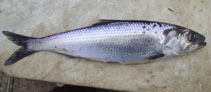
Ραχιαίες άκανθες (συνολικά) : 0; Εδρικές άκανθες: 0. Body fairly elongate, more `herring-like' than `shad-like'. Total gill rakers 59 to 155 (as in A. caspia), thick, coarse and shorter than gill filaments in some, long, thin and equal to or longer than gill filaments in others (i.e. A. kessleri volgensis). Teeth well developed in both jaws. Other Caspian shads have less than 50 gill rakers, except A. caspia which is deep-bodied.
Body shape (shape guide): fusiform / normal; Cross section: compressed.
Pelagic at sea, found in a wide variety of habitats. Migrates to middle reaches of large rivers, spawning close to shores in main channel and in almost still water bodies such as river bays and eddies and flood plains, at 4-5 years. Enters rivers with unripe gonads. Some spawn 2-4 seasons with most females dying after spawning. Spawners appear along the coast in March to April, entering rivers April to May when temperature reach about 9°C, peaking at 12-15°C. Duration of spawning originally lasting 30-50 days; it starts in may to August when temperature rises above 15°C and lasts as long as it remains at 15-23°C; it is most intensive between 4-10 p.m. Eggs are bathypelagic. Spent individuals return back to the sea to feed. In autumn, the fish move to the southern part of the sea to overwinter. Juveniles migrate to the sea or estuarine during the first summer until maturity (Ref. 59043). Feeds chiefly on small fishes, less frequently on insect larvae and crustaceans (the latter though being the main food for A. kessleri volgensis) (Ref. 10432). Two subspecies known. The flesh of A. k. kessleri is said to be the tastiest of all Caspian clupeids owing to its high fat content, averaging 18.9% by weight before the spawning period, diminishing to about 1.5% after spawning (Ref. 10432). Impoundment of main rivers significantly reduced available spawning sites and migration routes; heavy overfishing may have caused all population decline during the first decades of teh 20th century. Most spawning grounds were upriver of Volga and now are no longer accessible (Ref. 59043).
Spawns in rivers. Some enter with ripe gonads and spawn in the lower reaches or even delta (A. kessleri volgensis), others enter unripe and reach as much as 500 km upstream. The young descend in late summer and autumn.
Whitehead, P.J.P., 1985. FAO Species Catalogue. Vol. 7. Clupeoid fishes of the world (suborder Clupeoidei). An annotated and illustrated catalogue of the herrings, sardines, pilchards, sprats, shads, anchovies and wolf-herrings. FAO Fish. Synop. 125(7/1):1-303. Rome: FAO. (Ref. 188)
Κατάσταση Κόκκινου Καταλόγου IUCN (Ref. 130435: Version 2025-2 (Global))
Απειλή για τον άνθρωπο
Harmless
Ανθρώπινες χρήσεις
αλιεία: Εμπορικό(ά)
Εργαλεία
Ειδικές εκθέσεις
Λήψη XML
Διαδικτυακές πηγές
Εκτιμήσεις βάσει μοντέλων
Δείκτης φυλογενετικής ποικιλότητας (Αναφ.
82804): PD
50 = 0.5000 [Uniqueness, from 0.5 = low to 2.0 = high].
Bayesian length-weight: a=0.00776 (0.00499 - 0.01206), b=3.09 (2.96 - 3.22), in cm total length, based on LWR estimates for this species & Genus-body shape (Ref.
93245).
Τροφικό Επίπεδο (Αναφ.
69278): 4.5 ±0.7 se; based on diet studies.
Generation time: 2.3 ( na - na) years. Estimated as median ln(3)/K based on 1
growth studies.
Ελαστικότητα (Αναφ.
120179): Μεσαίο(α), ελάχιστος χρόνος για διπλασιασμό πληθυσμού 1,4 - 4,4 έτη (tm=3-5; Fec=135,000).
Ευπάθεια στην αλιεία (Ref.
59153): Low to moderate vulnerability (31 of 100).
🛈