>
Clupeiformes (Herrings) >
Alosidae (Shads and Sardines)
Etymology: Alosa: Latin, alausa = a fish cited by Ausonius and Latin, halec = pickle, dealing with the Greek word hals = salt; it is also the old Saxon name for shad = "alli" ; 1591 (Ref. 45335); alabamae: From the word alabamae, meaning from Alabama (Ref. 10294).
More on authors: Jordan & Evermann.
Entorno: milieu / zona climática / rango de profundidad / gama de distribución
Ecología
marino; agua dulce; salobre pelagic-neritic; anadromo (Ref. 138280). Subtropical; 44°N - 24°N, 96°W - 81°W
Western Central Atlantic: Gulf of Mexico (northern part, from the Mississippi delta eastward to the Choctawhatchee River in Florida; also in rivers from Iowa to Arkansas and across to West Virginia). Status of threat from Ref. 11858.
Tamaño / Peso / Edad
Madurez: Lm ? range ? - ? cm
Max length : 51.0 cm SL macho / no sexado; (Ref. 188); common length : 42.5 cm SL macho / no sexado; (Ref. 188); edad máxima reportada: 4 años (Ref. 12193)
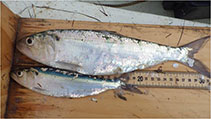
Espinas dorsales (total) : 0; Espinas anales: 0. Body moderately compressed, belly with distinct keel of scutes. Lower jaw steeply rising within mouth; no teeth present at front of jaws; upper jaw with a distinct notch. The only other shad of the Gulf of Mexico has only 20 to 24 gill rakers. Closely resembles A. aestivalis and A. pseudoharengus of Atlantic coasts, but in them the lower jaw rises very steeply in the mouth (Ref. 188).
Body shape (shape guide): fusiform / normal; Cross section: compressed.
Adults form schools. They ascend rivers and streams to spawn in spring or early summer, the young presumably descending in autumn. Marketed mostly fresh.
Ciclo vital y comportamiento de apareamiento
Madurez | Reproducción | Puesta | Huevos | Fecundidad | Larva
Spawns in freshwater in spring or early summer, ascending rivers and streams, the young presumably descending in autumn.
Whitehead, P.J.P., 1985. FAO Species Catalogue. Vol. 7. Clupeoid fishes of the world (suborder Clupeoidei). An annotated and illustrated catalogue of the herrings, sardines, pilchards, sprats, shads, anchovies and wolf-herrings. FAO Fish. Synop. 125(7/1):1-303. Rome: FAO. (Ref. 188)
Situación en la Lista Roja de la UICN (Ref. 130435: Version 2025-2 (Global))
Amenaza para el ser humano
Harmless
Usos humanos
Pesquerías: escaso valor comercial
Herramientas
Informes especiales
Descargar XML
Fuentes de Internet
Estimaciones basadas en modelos
Índice de diversidad filogenética (Referencia
82804): PD
50 = 0.5000 [Uniqueness, from 0.5 = low to 2.0 = high].
Bayesian length-weight: a=0.00708 (0.00338 - 0.01484), b=3.08 (2.91 - 3.25), in cm total length, based on LWR estimates for this Genus-body shape (Ref.
93245).
Nivel trófico (Referencia
69278): 2.7 ±0.28 se; based on food items.
Resiliencia (Referencia
120179): Medio, población duplicada en un tiempo mínimo de 1.4-4.4 años (tmax=4).
Vulnerabilidad pesquera (Ref.
59153): Moderate vulnerability (45 of 100).
🛈