>
Clupeiformes (Herrings) >
Alosidae (Shads and Sardines)
Etymology: Alosa: Latin, alausa = a fish cited by Ausonius and Latin, halec = pickle, dealing with the Greek word hals = salt; it is also the old Saxon name for shad = "alli" ; 1591 (Ref. 45335).
More on author: Mitchill.
Môi trường: môi trường / vùng khí hậu / Mức độ sâu / phạm vi phân phối
Sinh thái học
biển; nước ngọt; thuộc về nước lợ pelagic-neritic; di cư biển sông (để đẻ trứng) (Ref. 138280); mức độ sâu 5 - 55 m (Ref. 5951). Subtropical; 47°N - 27°N, 84°W - 60°W (Ref. 117456)
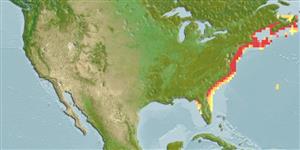
Western Atlantic: Cape Breton, Nova Scotia south to the St. John's River, Florida; also in lower parts of rivers (Ref. 188). Introduced in reservoirs in several states, and in the upper Tennessee River system in Tennessee, USA (Ref. 117456, 86798).
Bộ gần gũi / Khối lượng (Trọng lượng) / Tuổi
Chín muồi sinh dục: Lm ? range ? - ? cm
Max length : 40.0 cm SL con đực/không giới tính; (Ref. 7251); common length : 27.5 cm SL con đực/không giới tính; (Ref. 188); Khối lượng cực đại được công bố: 200.00 g (Ref. 7251); Tuổi cực đại được báo cáo: 8 các năm (Ref. 12193)
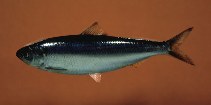
Các tia vây lưng cứng (tổng cộng) : 0; Các vây lưng mềm (tổng cộng) : 15 - 20; Tia cứng vây hậu môn: 0; Tia mềm vây hậu môn: 15 - 21; Động vật có xương sống: 47 - 53. Moderately compressed, belly with distinct keel of scutes. Upper jaw with a distinct notch; lower jaw rising steeply within mouth; minute teeth present at front of jaws (disappearing with age). Lower gill rakers 41 to 52 (fewer in fishes under 10 cm standard length), slender. Back dark blue, sometimes bluish-grey; a dark spot on shoulder (Ref. 188). Peritoneum black (Ref. 7251). Branchiostegal rays 7 (Ref. 4639).
Body shape (shape guide): fusiform / normal; Cross section: compressed.
Adults inhabit rivers, estuaries, coastal waters, lakes and reservoirs (Ref. 117456). They are found in saltwater except during the spawning season and occur up to at least 200 km offshore (Ref. 117456). They form schools and possibly wintering near the bottom and out from the coast, approaching the shore in the late spring. They feed on small fishes, copepods and small shrimps. Spawning occurs in brackish- or freshwaters of rivers, arriving in coastal waters a month or so later than A. pseudoharengus (in April at Chesapeake Bay, apparently when the water is above 7.0° C and later further north). Eggs are essentially pelagic, demersal in still water (Ref. 4639). Larvae are found in fresh and brackish rivers (Ref. 4639). Juveniles leave fresh and brackish nursery grounds at about 5 cm, migrating downstream (Ref. 4639). In freshwater habitat, this species usually occurs in current over rocky bottom (Ref. 86798). Marketed mostly fresh and salted (Ref. 188). Parasites found are acanthocephalan and nematodes (Ref. 37032).
Upriver movement to spawning areas occur in late afternoon or at night (Ref. 4639).
Whitehead, P.J.P., 1985. FAO Species Catalogue. Vol. 7. Clupeoid fishes of the world (suborder Clupeoidei). An annotated and illustrated catalogue of the herrings, sardines, pilchards, sprats, shads, anchovies and wolf-herrings. FAO Fish. Synop. 125(7/1):1-303. Rome: FAO. (Ref. 188)
Tình trạng Sách đỏ IUCN (Ref. 130435: Version 2025-2 (Global))
Mối đe dọa đối với con người
Harmless
Sử dụng của con người
Các nghề cá: tính thương mại
Các công cụ
Báo cáo đặc biệt
Tải xuống XML
Các nguồn internet
Ước tính dựa trên mô hình
Nhiệt độ ưa thích (Tài liệu tham khảo
123201): 11.5 - 24.7, mean 23.7 °C (based on 86 cells).
Chỉ số đa dạng phát sinh loài (Tài liệu tham khảo
82804): PD
50 = 0.5000 [Uniqueness, from 0.5 = low to 2.0 = high].
Bayesian length-weight: a=0.00708 (0.00410 - 0.01222), b=3.11 (2.97 - 3.25), in cm total length, based on LWR estimates for this species & Genus-body shape (Ref.
93245).
Mức dinh dưỡng (Tài liệu tham khảo
69278): 3.8 ±0.3 se; based on diet studies.
Thích nghi nhanh (Tài liệu tham khảo
120179): Trung bình, thời gian nhân đôi của chủng quần tối thiểu là 1.4 - 4.4 năm (K=0.18; tm=4; Fec=45,800).
Sự dễ bị tổn thương của nghề đánh cá (Ref.
59153): Moderate vulnerability (39 of 100).
🛈
Sự dễ bị tổn thương của khí hậu (Ref.
125649): Moderate to high vulnerability (50 of 100).
🛈
Chất dinh dưỡng (Ref.
124155): Calcium = 28.1 [13.7, 137.6] mg/100g; Iron = 1.47 [0.63, 3.85] mg/100g; Protein = 19.8 [17.4, 22.6] %; Omega3 = 0.744 [0.386, 1.503] g/100g; Selenium = 18 [9, 36] μg/100g; VitaminA = 18.7 [4.7, 78.7] μg/100g; Zinc = 0.505 [0.325, 0.920] mg/100g (wet weight);