>
Clupeiformes (Herrings) >
Clupeidae (Herrings, shads, sardines, menhadens)
Etymology: Hyperlophus: Greek, hyper = over + Greek, lophos = crest (Ref. 45335).
More on author: Castelnau.
Entorno: milieu / zona climática / rango de profundidad / gama de distribución
Ecología
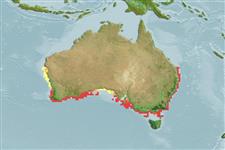
marino; salobre pelagic-neritic; anfidromo (Ref. 51243); rango de profundidad 10 - 13 m. Temperate; 25°S - 40°S, 112°E - 155°E (Ref. 188)
Western Pacific: southern Australia, from Kalbarri, Western Australia to South Australia, New South Wales and Moreton Bay, Queensland.
Tamaño / Peso / Edad
Madurez: Lm ? range ? - ? cm
Max length : 10.0 cm SL macho / no sexado; (Ref. 188)
Descripción breve
Claves de identificación | Morfología | Morfometría
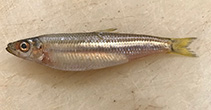
Espinas dorsales (total) : 0; Radios blandos dorsales (total) : 12 - 18; Espinas anales: 0; Radios blandos anales: 16 - 27. Body fairly elongate, belly keeled, with 19 to 24 - 10 to 13 scutes; 23 to 27 dorsal scutes with low keels from head to dorsal fin origin. Second supra-maxilla paddle-shaped, lower portion larger. Branchiostegal rays 4. Anal fin origin an eye diameter or more behind base of last dorsal fin ray. Scales more or less firm on body; a silvery band along flank.
Body shape (shape guide): elongated.
Schools in large numbers in shallow sandy areas of bays and estuaries.
Ciclo vital y comportamiento de apareamiento
Madurez | Reproducción | Puesta | Huevos | Fecundidad | Larva
Whitehead, P.J.P., 1985. FAO Species Catalogue. Vol. 7. Clupeoid fishes of the world (suborder Clupeoidei). An annotated and illustrated catalogue of the herrings, sardines, pilchards, sprats, shads, anchovies and wolf-herrings. FAO Fish. Synop. 125(7/1):1-303. Rome: FAO. (Ref. 188)
Situación en la Lista Roja de la UICN (Ref. 130435: Version 2025-2 (Global))
Amenaza para el ser humano
Harmless
Usos humanos
Pesquerías: pesquerías de subsistencia; carnada: usually
Herramientas
Informes especiales
Descargar XML
Fuentes de Internet
Estimaciones basadas en modelos
Temperatura preferida (Referencia
123201): 15.3 - 23.6, mean 18 °C (based on 193 cells).
Índice de diversidad filogenética (Referencia
82804): PD
50 = 0.7500 [Uniqueness, from 0.5 = low to 2.0 = high].
Bayesian length-weight: a=0.00389 (0.00180 - 0.00842), b=3.12 (2.94 - 3.30), in cm total length, based on all LWR estimates for this body shape (Ref.
93245).
Nivel trófico (Referencia
69278): 3.4 ±0.45 se; based on food items.
Resiliencia (Referencia
120179): Alto, población duplicada en un tiempo mínimo inferior a 15 meses (Preliminary K or Fecundity.).
Vulnerabilidad pesquera (Ref.
59153): Low vulnerability (10 of 100).
🛈
Nutrientes (Ref.
124155): Calcium = 168 [73, 338] mg/100g; Iron = 0.858 [0.448, 1.717] mg/100g; Protein = 18.7 [17.3, 20.0] %; Omega3 = 0.695 [0.331, 1.479] g/100g; Selenium = 6.96 [2.61, 17.54] μg/100g; VitaminA = 26.6 [8.4, 86.4] μg/100g; Zinc = 1.19 [0.78, 1.84] mg/100g (wet weight);