>
Anguilliformes (Eels and morays) >
Ophichthidae (Snake eels) > Ophichthinae
Etymology: Ophichthus: Greek, ophis = serpent + Greek, ichthys = fish (Ref. 45335).
Eponymy: Prince Charles Lucien Bonaparte (originally Jules Laurent Lucien) (1803–1857) was a nephew of Napoleon Bonaparte and a renowned biologist and zoologist. [...] (Ref. 128868), visit book page.
More on author: Kaup.
Ambiente: milieu / zona climatica / distribuzione batimetrica / gamma di distribuzione
Ecologia
marino associati a barriera corallina; distribuzione batimetrica 1 - 20 m (Ref. 3972). Tropical
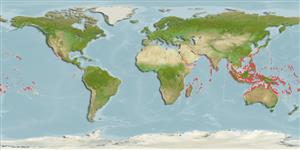
Indo-Pacific: off Durban, South Africa, then from Mauritius to Indonesia; north to Japan, south to Australia.
Dimensione / Peso / Età
Maturità: Lm ? range ? - ? cm
Max length : 75.0 cm TL maschio/sesso non determinato; (Ref. 3972)
Breve descrizione
Chiavi di identificazione | Morfologia | Morfometria
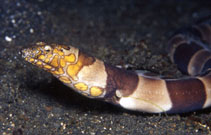
Vertebre: 156 - 164. Golden yellow to cream with 18-27 prominent black saddles, a few meeting below (Ref. 3972). Dorsal and anal margin with irregular spots and golden marbling and spots on snout and head (Ref. 3972). Body broadly banded with black and white (Ref. 48635).
Body shape (shape guide): eel-like; Cross section: circular.
Inhabits sand flats of lagoon and seaward reefs to a depth of over 20 m (Ref. 37816). Burrowing species of inshore waters (Ref. 75154). Feeds on small fishes, and probably crustaceans (Ref. 89972). Only the head is usually visible from the sand during the day (Ref. 48635). Solitary in sand (Ref 90102). Minimum depth reported taken from Ref. 86942.
Ciclo vitale e comportamento di accoppiamento
Maturità | Riproduzione | Deposizione | Uova | Fecondità | Larve
McCosker, J.E. and P.H.J. Castle, 1986. Ophichthidae. p. 176-186. In M.M. Smith and P.C. Heemstra (eds.) Smiths' sea fishes. Springer-Verlag, Berlin. (Ref. 3972)
Stato della Lista Rossa IUCN (Ref. 130435: Version 2025-2 (Global))
Minaccia per l'uomo
Harmless
Usi umani
Pesca: di nessun interesse
Strumenti
Rapporti speciali
Scarica XML
Fonti Internet
Stime basate su modelli
Temperatura preferita (Fonte Biblio.
123201): 24.7 - 29.3, mean 28.3 °C (based on 2421 cells).
Indice di diversità filogenetica (Fonte Biblio.
82804): PD
50 = 0.5000 [Uniqueness, from 0.5 = low to 2.0 = high].
Bayesian length-weight: a=0.00093 (0.00041 - 0.00214), b=2.99 (2.79 - 3.19), in cm total length, based on LWR estimates for this (Sub)family-body shape (Ref.
93245).
Livello trofico (Fonte Biblio.
69278): 4.0 ±0.7 se; based on size and trophs of closest relatives
Resilienza (Fonte Biblio.
120179): Medio, tempo minimo di raddoppiamento della popolazione 1.4 - 4.4 anni (Preliminary K or Fecundity.).
Vulnerabilità della pesca (Ref.
59153): Moderate to high vulnerability (50 of 100).
🛈