Klassifizierung / Names
Namen | Synonyme | Catalog of Fishes(Gattung, Arten) | ITIS | CoL | WoRMS | Cloffa
>
Clupeiformes (Herrings) >
Ehiravidae (River sprats)
Etymology: Clupeoides: Latin, clupea = sardine, derived from Clupeus = shield; + Greek, oides = similar (Ref. 45335).
More on authors: Weber & deBeaufort.
Umwelt: Milieu / Klimazone / Tiefenbereich / Verbreitungsgebiet
Ökologie
; süßwasser pelagisch. Tropical; 5°S - 8°S
Asia and Oceania: Indonesia (Lorentz River, Irian Jaya) and Papua New Guinea (Fly River); probably in other southwest-flowing rivers in area.
Größe / Gewicht / Alter
Geschlechtsreife: Lm ? range ? - ? cm
Max length : 9.0 cm SL Männchen/unbestimmt; (Ref. 2847)
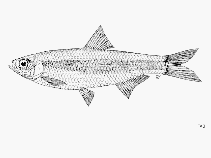
Rückenflossenstacheln (insgesamt) : 0; Rückenflossenweichstrahlen (insgesamt) : 12 - 18; Afterflossenstacheln: 0; Afterflossenweichstrahlen: 16 - 27. Body moderately deep, belly sharply keeled, with 9 to 12 + 7 to 9 scutes. Snout blunt, pre-maxillae short and toothless, but prominent teeth in lower jaw; second supra-maxilla short, a little over half length of maxilla blade. Pectoral axillary scale small, less than 1/3 length of fin. A silver stripe along flank.
Body shape (shape guide): fusiform / normal; Cross section: compressed.
The only clupeid in the world known to inhabit mountainous rivers (Ref. 2847). Occurs in streams with gravel or stony bottoms and feeds primarily on aquatic insect larvae (Ref. 2847).
Lebenszyklus und Paarungsverhalten
Geschlechtsreife | Fortpflanzung | Ablaichen | Eier | Fruchtbarkeit | Larven
Whitehead, P.J.P., 1985. FAO Species Catalogue. Vol. 7. Clupeoid fishes of the world (suborder Clupeoidei). An annotated and illustrated catalogue of the herrings, sardines, pilchards, sprats, shads, anchovies and wolf-herrings. FAO Fish. Synop. 125(7/1):1-303. Rome: FAO. (Ref. 188)
IUCN Rote Liste Status (Ref. 130435: Version 2025-2 (Global))
Bedrohung für Menschen
Harmless
Nutzung durch Menschen
Fischereien: kleinfischerei
Tools
Zusatzinformationen
Download XML
Internet Quellen
Schätzungen auf der Grundlage von Modellen
Phylogenetischer Diversitätsindex (Ref.
82804): PD
50 = 0.5625 [Uniqueness, from 0.5 = low to 2.0 = high].
Bayesian length-weight: a=0.00891 (0.00380 - 0.02091), b=3.03 (2.83 - 3.23), in cm total length, based on LWR estimates for this (Sub)family-body shape (Ref.
93245).
Trophische Ebene (Ref.
69278): 3.2 ±0.40 se; based on food items.
Widerstandsfähigkeit (Ref.
120179): hoch, Verdopplung der Population dauert weniger als 15 Monate. (Preliminary K or Fecundity.).
Anfälligkeit der Fischerei (Ref.
59153): Low vulnerability (10 of 100).
🛈