>
Pleuronectiformes (Flatfishes) >
Bothidae (Lefteye flounders)
Etymology: Engyprosopon: Greek, eggys = nearly + Greek,prosopon = a face (Ref. 45335).
Entorno: milieu / zona climática / rango de profundidad / gama de distribución
Ecología
marino demersal; rango de profundidad 67 - 88 m (Ref. 9824). Tropical
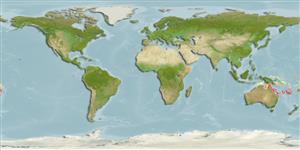
Western Central Pacific: Chesterfield and Bellona Plateaus and Fairway Ridge, Coral Sea.
Tamaño / Peso / Edad
Madurez: Lm ? range ? - ? cm
Max length : 8.6 cm SL macho / no sexado; (Ref. 9824)
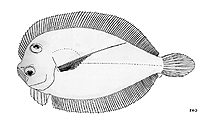
Pelvic fin on eyed short (3.1 to 3.2 times in head length in both sexes) and with some black spots. Pectoral-fin length on eyed side about twice as long as head in males, subequal to or more than head length in females. Interorbital region uniformly coloured (Ref 42535).
Body shape (shape guide): short and / or deep.
Ciclo vital y comportamiento de apareamiento
Madurez | Reproducción | Puesta | Huevos | Fecundidad | Larva
Hensley, D.A. and K. Amaoka, 2001. Bothidae. Lefteye flounders. p. 3799-3841. In K.E. Carpenter and V. Niem (eds.) FAO species identification guide for fishery purposes. The living marine resources of the Western Central Pacific. Vol. 6. Bony fishes part 4 (Labridae to Latimeriidae), estuarine crocodiles. FAO, Rome. (Ref. 9824)
Situación en la Lista Roja de la UICN (Ref. 130435: Version 2025-2 (Global))
Amenaza para el ser humano
Harmless
Usos humanos
Herramientas
Informes especiales
Descargar XML
Fuentes de Internet
Estimaciones basadas en modelos
Temperatura preferida (Referencia
123201): 21.3 - 24.9, mean 24.2 °C (based on 3 cells).
Índice de diversidad filogenética (Referencia
82804): PD
50 = 0.5000 [Uniqueness, from 0.5 = low to 2.0 = high].
Bayesian length-weight: a=0.00912 (0.00412 - 0.02018), b=3.05 (2.87 - 3.23), in cm total length, based on LWR estimates for this (Sub)family-body shape (Ref.
93245).
Nivel trófico (Referencia
69278): 3.5 ±0.4 se; based on size and trophs of closest relatives
Resiliencia (Referencia
120179): Medio, población duplicada en un tiempo mínimo de 1.4-4.4 años (Preliminary K or Fecundity.).
Vulnerabilidad pesquera (Ref.
59153): Low vulnerability (10 of 100).
🛈