>
Pleuronectiformes (Flatfishes) >
Bothidae (Lefteye flounders)
Etymology: Asterorhombus: Greek, aster = star + Greek, rhombos = paralelogram (Ref. 45335); cocosensis: Named for its type locality, Cocos Island (Ref. 57759).
More on author: Bleeker.
Environnement : milieu / zone climatique / profondeur / gamme de distribution
Écologie
marin démersal; profondeur 1 - 30 m (Ref. 57759). Tropical
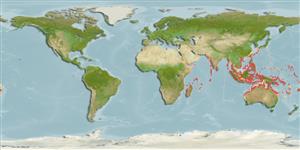
Indo-West Pacific: Mozambique to Fiji; north to Japan, south to Queensland, Australia (not occurring nonmarginally on the Pacific Plate).
Taille / Poids / Âge
Maturité: Lm ? range ? - ? cm
Max length : 12.0 cm SL mâle / non sexé; (Ref. 57759)
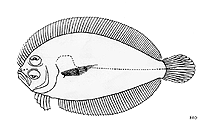
Rayons mous dorsaux (Total) : 79 - 83; Rayons mous anaux: 59 - 64; Vertèbres: 35 - 36. This species is characterized by the following: body depth 51.5-58.3; sexual dimorphism
in interorbital width, in specimens approximately 6.0 cm SL, males 4.1-7.9, females 3.2-5.0; first dorsal-fin ray isometric relative to SL, with distinct membranous structure confined to tip. Pectoral fin count at the ocular side 10-13, blind side 8-11. The membranous structure at the tip of the first dorsal fin resembles a small fish or crustacean (possibly a small hippolytid shrimp), authors called the ray the illicium and the structure at the tip as the esca (Ref. 57759).
Body shape (shape guide): short and / or deep; Cross section: flattened.
Found on pale sandy substrates in clearwater coastal bays to outer reef lagoons and sandy gutters on reef flats. Often crawls over low stony reef (Ref. 48637). The membranous structure at the tip of the first dorsal fin resembles a small fish or crustacean (possibly a small hippolytid shrimp), authors called the ray the illicium and the structure at the tip as the esca. The illicium waves the esca back and forth near mouth to attract prey. Shows sexual dimorphism in width of the interorbital origin, wider in males than females. Most frequently collected by divers.
Cycle de vie et comportement reproducteur
Maturité | Reproduction | Frai | Œufs | Fécondité | Larves
Hensley, D.A., 2005. Revision of the genus Asterorhombus (Pleuronectiformes: Bothidae). Copeia 2005(3):445-460. (Ref. 57759)
Statut dans la liste rouge de l'IUCN (Ref. 130435: Version 2025-2 (Global))
Menace pour l'homme
Harmless
Utilisations par l'homme
Outils
Articles particuliers
Télécharger en XML
Sources Internet
Estimations basées sur des modèles
Température préférée (Réf.
123201): 24.8 - 29.3, mean 28.4 °C (based on 3223 cells).
Indice de diversité phylogénétique (Réf.
82804): PD
50 = 0.6250 [Uniqueness, from 0.5 = low to 2.0 = high].
Bayesian length-weight: a=0.00912 (0.00412 - 0.02018), b=3.05 (2.87 - 3.23), in cm total length, based on LWR estimates for this (Sub)family-body shape (Ref.
93245).
Niveau trophique (Réf.
69278): 3.6 ±0.59 se; based on food items.
Résilience (Réf.
120179): Milieu, temps minimum de doublement de population : 1,4 à 4,4 années (Preliminary K or Fecundity.).
Vulnérabilité de la pêche (Ref.
59153): Low vulnerability (10 of 100).
🛈