>
Clupeiformes (Herrings) >
Ehiravidae (River sprats)
Etymology: Gilchristella: Because of John Gilchrist, father of the South African ichthyology; Cape Town, 1925.
Eponymy: Dr John Dow Fisher Gilchrist (1866–1926) was a Scottish-born South African ichthyologist and naturalist. [...] Dr John Dow Fisher Gilchrist (1866–1926) was a Scottish-born South African ichthyologist and naturalist. [...] (Ref. 128868), visit book page.
Môi trường: môi trường / vùng khí hậu / Mức độ sâu / phạm vi phân phối
Sinh thái học
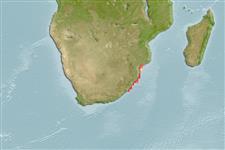
biển; nước ngọt; thuộc về nước lợ pelagic-neritic; sống cả ở nước ngọt và nuớc mặn. Subtropical; 25°S - 36°S, 17°E - 34°E (Ref. 188)
Africa: Lake Piti, Mozambique, along south and east coasts of South Africa to Saldanha Bay (Ref. 188, 3509), and as far north as the Olifants River on the west coast (Ref. 7248), possibly to mouth of Orange River (Ref. 188, 3259). Also reported from Madagascar (Ref. 3509, 13333), but its presence is not confirmed; it is probably based on confusion with Sauvagella madagascariensis, while Gilchristella aestuaria does not occur in Madagascar (Ref. 33664). Reported occurrence in India (Ref. 32693) is of dubious validity (Ref. 33664). Currently a single species, but at least two forms, possibly different species, are known (Ref. 52193).
Chiều dài lúc trưởng thành đầu tiên / Bộ gần gũi / Khối lượng (Trọng lượng) / Tuổi
Chín muồi sinh dục: Lm 2.8, range 2 - 3 cm
Max length : 9.0 cm SL con đực/không giới tính; (Ref. 52193); Tuổi cực đại được báo cáo: 6 các năm (Ref. 7248)
Các tia vây lưng cứng (tổng cộng) : 0; Các vây lưng mềm (tổng cộng) : 14 - 15; Tia cứng vây hậu môn: 0; Tia mềm vây hậu môn: 20. Diagnosis: Body rather compressed, belly rounded, with 6 to 9 thin unkeeled pre-pelvic scutes followed by an equally thin pelvic scute, all with slender ascending arms; no post-pelvic scutes; snout pointed, lower jaw a little prominent, with a single row of fine teeth in each jaw; posterior supra-maxilla paddle-shaped; gillrakers 39 to 76, gillrakers small but present on posterior face of third epibranchial; pelvic fin with i-7 finrays, under or a little before dorsal fin origin (Ref. 188). Resembles Spratelloides species or juvenile Etrumeus and Dussumieria, but pre-pelvic scutes present; other clupeids occuring in same area have keeled pre-pelvic and post-pelvic scutes (Ref. 188).
Body shape (shape guide): fusiform / normal; Cross section: oval.
Occurs in the sea, but found mostly in estuaries; also found in landlocked brackish and freshwater lagoons (Ref. 93596), also rivers and lakes (Ref. 188). Maximum size 10 cm (Ref. 4967). Entire life cycle is completed in the estuary (Ref. 32693). Breeds throughout the year with a peak in spring and early summer (Ref. 7248, 52193). Maturity may be attained within the first or second year and an age of up to 5 or 6 years is recorded (Ref. 7248, 52193). Feeds chiefly on zooplankton by filtering or selecting individual organisms from the water column (Ref. 7248, 52193). It can tolerate salinities under 4 ppt and of up to 52.6 ppt (Ref. 32693). Utilized fresh or dried and salted (Ref. 12484).
A semelparous species that grows to maturity and spawns in one year (Ref. 34361).
Skelton, P.H., 1993. A complete guide to the freshwater fishes of southern Africa. Southern Book Publishers. 388 p. (Ref. 7248)
Tình trạng Sách đỏ IUCN (Ref. 130435: Version 2025-2 (Global))
Mối đe dọa đối với con người
Harmless
Sử dụng của con người
Các nghề cá: các nghề cá là sinh kế; mồi: usually
Các công cụ
Báo cáo đặc biệt
Tải xuống XML
Các nguồn internet
Ước tính dựa trên mô hình
Chỉ số đa dạng phát sinh loài (Tài liệu tham khảo
82804): PD
50 = 1.0000 [Uniqueness, from 0.5 = low to 2.0 = high].
Bayesian length-weight: a=0.00955 (0.00468 - 0.01948), b=3.06 (2.88 - 3.24), in cm total length, based on LWR estimates for this species & (Sub)family-body (Ref.
93245).
Mức dinh dưỡng (Tài liệu tham khảo
69278): 3.1 ±0.3 se; based on size and trophs of closest relatives
Thích nghi nhanh (Tài liệu tham khảo
120179): Chiêù cao, thời gian nhân đôi của chủng quần tối thiểu là dưới 15 tháng (tm=0.5).
Sự dễ bị tổn thương của nghề đánh cá (Ref.
59153): Low vulnerability (10 of 100).
🛈