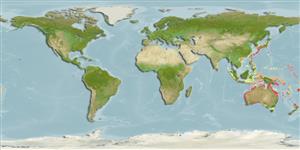
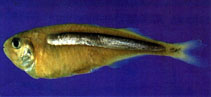
Ambiente: milieu / zona climatica / distribuzione batimetrica / gamma di distribuzione
Ecologia
marino; salmastro pelagic-neritic. Temperate
Indo-Pacific: around the coasts of Australia and probably throughout the Pacific Ocean as they have been collected as far north as Taiwan and Japan.
Dimensione / Peso / Età
Maturità: Lm ? range ? - ? cm
Max length : 7.5 cm TL maschio/sesso non determinato; (Ref. 9769)
Spine dorsali (totale) : 4 - 7; Raggi dorsali molli (totale) : 10 - 17; Spine anali: 1; Raggi anali molli: 20 - 28. Teeth in jaws in single row, covering about half free edge of premaxilla. Two postmaxillary processes scarcely developed.
Body shape (shape guide): elongated.
Most commonly found in surf around rocky headlands and along the shoreline, occasionally also in more still waters of river mouths. Very delicate and do not survive handling. Appear to be able to hybridize with congeners, Iso flosmaris and Iso hawaiiensis. Nothing else is known about this species. (Ref. 9769).
Ciclo vitale e comportamento di accoppiamento
Maturità | Riproduzione | Deposizione | Uova | Fecondità | Larve
Ivantsoff, W., 1999. Isonidae. Surf sardines. p. 2140-2143. In K.E. Carpenter and V.H. Niem (eds.) FAO species identification guide for fishery purposes. The living marine resources of the Western Central Pacific. Volume 4. Bony fishes part 2 (Mugilidae to Carangidae). FAO, Rome. (Ref. 9769)
Stato della Lista Rossa IUCN (Ref. 130435: Version 2025-2 (Global))
Minaccia per l'uomo
Harmless
Usi umani
Pesca: di nessun interesse
Strumenti
Rapporti speciali
Scarica XML
Fonti Internet
Stime basate su modelli
Temperatura preferita (Fonte Biblio.
123201): 17.9 - 28.7, mean 26.2 °C (based on 983 cells).
Indice di diversità filogenetica (Fonte Biblio.
82804): PD
50 = 0.5625 [Uniqueness, from 0.5 = low to 2.0 = high].
Bayesian length-weight: a=0.00389 (0.00180 - 0.00842), b=3.12 (2.94 - 3.30), in cm total length, based on all LWR estimates for this body shape (Ref.
93245).
Livello trofico (Fonte Biblio.
69278): 3.1 ±0.3 se; based on size and trophs of closest relatives
Vulnerabilità della pesca (Ref.
59153): Low vulnerability (10 of 100).
🛈