>
Clupeiformes (Herrings) >
Dorosomatidae (Gizzard shads and sardinellas)
Etymology: Sierrathrissa: Latin, serra = saw + Greek, thrissa, -es = shad (Ref. 45335); leonensis: The generic and specific names make allusion to the known geographic range of this genus and species (Ref. 121309).
Lingkungan: lingkungan / zona iklim / kisaran kedalaman / jangkauan distribusi
Ekologi
; air tawar pelagis, permukaan; kisaran kedalaman 0 - 8 m (Ref. 188). Tropical; 18°N - 0°N
Africa: rivers of West Africa (Ref. 188), from Senegal to Cameroon (Ref. 3509), including Senegal, Gambia, Bia and Niger rivers (Ref. 81269), and Wouri and Sanaga rivers in Cameroon (Ref. 51193, 81631); also in the man-made lakes Kainji in Nigeria and Volta in Ghana (Ref. 188, 81269).
Panjang pada saat jatuh tempo pertama / Ukuran / Berat / umur
Kematangan: Lm ?, range 2 - ? cm
Max length : 3.5 cm SL jantan/; (Ref. 130826); common length : 2.3 cm SL jantan/; (Ref. 188)
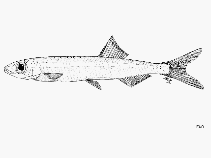
Duri punggung (Keseluruhan (total)) : 0; duri punggung lunak (Keseluruhan (total)) : 12 - 15; Duri dubur: 0; Sirip dubur lunak: 16 - 20; vertebrata, bertulang belakang: 36 - 41. Diagnosis: Small, slender fishes, easily mistaken for the juveniles of Pellonula (Ref. 188). Belly rounded, with 0-10 minute pre-pelvic scutes, without arms, supporting a low membranous keel, post-pelvic scutes similar, the keel more apparent, and a W-shaped scute located at the pelvic fin bases; lower gillrakers 13-16; pelvic insertion well before dorsal fin, with 1 unbranched and 5-6 branched rays; anal fin beginning under dorsal fin base (Ref. 188, 2849, 81269, 81631, 120915, 121309). It commmonly occurs with Pellonula, which has pelvic fins with 1 unbranched and 7 branched rays, normal scutes and the pelvic fin insertion more or less below the dorsal fin origin (Ref. 188).
Body shape (shape guide): elongated; Cross section: oval.
A riverine species, but also in man-made lakes (Ref. 188). Schooling in open waters and at about 2 to 8 m in Lake Kainji, rising to about 30 cm from the surface at night in Lake Volta (Ref. 188, 3034). It feeds on plankton, especially cladocerans and rotifers (Ref. 188, 120915). It breeds at about 1.8-2.0 cm standard length (Ref. 188).
Whitehead, P.J.P., 1985. FAO Species Catalogue. Vol. 7. Clupeoid fishes of the world (suborder Clupeoidei). An annotated and illustrated catalogue of the herrings, sardines, pilchards, sprats, shads, anchovies and wolf-herrings. FAO Fish. Synop. 125(7/1):1-303. Rome: FAO. (Ref. 188)
Status IUCN Red List (Ref. 130435: Version 2025-2 (Global))
ancaman kepada manusia
Harmless
penggunaan manusia
Perikanan: komersial
Alat, peralatan
laporan khas
muat turun XML
Sumber internet
Estimasi berdasarkan model
Indeks keanekaragaman filogenetik (Acuan
82804): PD
50 = 1.0000 [Uniqueness, from 0.5 = low to 2.0 = high].
Bayesian length-weight: a=0.00490 (0.00249 - 0.00964), b=2.94 (2.77 - 3.11), in cm total length, based on LWR estimates for this species & (Sub)family-body (Ref.
93245).
Tingkat Trofik (Acuan
69278): 3.1 ±0.30 se; based on food items.
Daya lenting (Acuan
120179): Tinggi, Waktu penggandaan populasi minimum kurang dari 15 bulan (tm<1).
Kerentanan Penangkapan Ikan (Ref.
59153): Low vulnerability (10 of 100).
🛈