>
Clupeiformes (Herrings) >
Dorosomatidae (Gizzard shads and sardinellas)
Etymology: Microthrissa: Grek, mikros = small + Greek, thrissa, -es = shad (Ref. 45335).
More on author: Poll.
Окружающая среда: среда / климатическая зона / пределы глубины / диапазон распространения
экология
; пресноводный пелагический. Tropical; 3°N - 7°S
Africa: Congo River system in Dungu River and its tributary Garamba River (Ref. 188), and Lower Congo River (Ref. 188) in Democratic Republic of the Congo (Ref. 47399). Also reported as Microthrissa cf. minuta from mouth of Niemba River, Lukuga River, an outflow of Lake Tanganyika, in Democratic Republic of the Congo (Ref. 93587).
Размер / Вес / Возраст
половая зрелость: Lm ? range ? - ? cm
Max length : 4.3 cm SL самец/пол неопределен; (Ref. 47399)
Краткое описание
определительные ключи | морфология | морфометрия
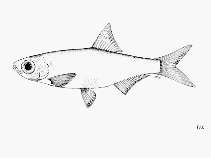
колючие лучи спинного плавника (общее число) : 0; членистые (мягкие) лучи спинного плавника (общее число) : 12 - 15; колючие лучи анального плавника: 0; членистые (мягкие) лучи анального плавника: 18 - 21; позвонки: 40 - 44. Diagnosis: Body moderately deep, its depth about 22-30% of standard length; scutes strongly keeled, 1 or 2 before base of first pectoral fin ray, 11-12 pre-pelvic and 6-8 post-pelvic scutes; snout pointed; lower jaw not or slightly projecting, included in upper when mouth closed, with small teeth limited to anterior part; pre-maxilla with 12-30 small conical teeth directed inwards; maxilla blade slender, more than 3 times as long as deep, upper edge with a ridge flared outward; posterior supra-maxilla small, spatulate, shaft as long as blade; lower gillrakers 18-22 (Ref. 188, 47399, 93833). Also characterized by 37-43 scales in a longitudinal series and anal fin with 18-21 rays (Ref. 47399). It resembles Microthrissa royauxi, which has fewer gillrakers but more anal fin rays, 14-17 and 23-27 respectively (Ref. 188). It is distinguished from Microthrissa whiteheadi by a lower number of teeth on the pre-maxilla, 12-30 vs. 32-40 in M. whiteheadi; and additionally by a higher number of lower gillrakers, 18-22 vs. 14-18, a lower number of anal fin rays, 18-21 vs. 20-25, and a lower number of pre-pelvic scutes, 11-12 vs. 13-16 (Ref. 46514, 47399).
Body shape (shape guide): fusiform / normal; Cross section: compressed.
A riverine species (Ref. 188).
Жизненный цикл и брачное поведение
половая зрелость | размножение | нерест | икра | Плодовитость | личинки
Gourène, G. and G.G. Teugels, 1989. Révision systématique du genre Microthrissa Boulenger, 1902 des eaux douces africaines (Pisces, Clupeidae). Rev. Hydrobiol. Trop. 22(2):129-156. (Ref. 47399)
Статус Красного Списка МСОП (Ref. 130435: Version 2025-2 (Global))
Угроза для людей
Harmless
Использование человеком
рыболовство: рыболовство как средство для существования
дополнительная информация
инструменты
Специальные отчеты
Скачать в формате XML
ресурсы в Интернет
Оценки, основанные на моделях
Индекс филогенетического разнообразия (ссылка
82804): PD
50 = 0.5312 [Uniqueness, from 0.5 = low to 2.0 = high].
Bayesian length-weight: a=0.00871 (0.00414 - 0.01834), b=3.06 (2.89 - 3.23), in cm total length, based on LWR estimates for this (Sub)family-body shape (Ref.
93245).
Трофический уровень (ссылка
69278): 3.1 ±0.3 se; based on size and trophs of closest relatives
устойчивость к внешним воздействиям (ссылка
120179): высокий, минимальное время удвоения популяции до 15 месяцев (Preliminary K or Fecundity.).
Уязвимость рыбной ловли (Ref.
59153): Low vulnerability (10 of 100).
🛈