>
Clupeiformes (Herrings) >
Dorosomatidae (Gizzard shads and sardinellas)
Etymology: Microthrissa: Grek, mikros = small + Greek, thrissa, -es = shad (Ref. 45335).
More on author: Regan.
Environnement : milieu / zone climatique / profondeur / gamme de distribution
Écologie
; eau douce pélagique. Tropical; 10°N - 10°S
Africa: widely distributed in the Congo River basin (Ref. 28136, 47399), from the Lower Congo River near its estuary up to the Upper Lualaba River, but excluding the Luapula-Mweru (Ref. 188).
Taille / Poids / Âge
Maturité: Lm ? range ? - ? cm
Max length : 7.0 cm SL mâle / non sexé; (Ref. 93833)
Description synthétique
Clés d'identification | Morphologie | Morphométrie
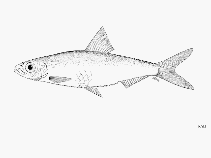
Épines dorsales (Total) : 0; Rayons mous dorsaux (Total) : 13 - 15; Épines anales: 0; Rayons mous anaux: 18 - 22; Vertèbres: 42 - 45. Diagnosis: Body slender, its depth about 20-24% of standard length; scutes strongly keeled, beginning under pectoral fin base, with 10-15 pre-pelvic and 8-11 post-pelvic scutes; snout rather blunt or acute; lower jaw not or slightly projecting, included in upper when mouth closed, with small teeth limited to anterior part; pre-maxillae with a single row of 24-42 small conical teeth directed inwards; maxilla slender, its blade more than 3 times as long as deep, upper edge quite strongly ridged; posterior supra-maxilla slender, spatulate, with distinct anterior shaft, shaft longer than blade; lower gillrakers 17-24 (Ref. 188, 47399). Also characterized by 26-35 scales in a longitudinal series and anal fin with 18-22 rays (Ref. 47399). It differs from Microthrissa moeruensis in having a distinctly blunter snout and less scales in longitudinal series (Ref. 188, 47399).
Body shape (shape guide): fusiform / normal; Cross section: compressed.
Found in rivers and lakes, apparently in both still and running water; seems to occur in rather acid waters (Ref. 188).
Cycle de vie et comportement reproducteur
Maturité | Reproduction | Frai | Œufs | Fécondité | Larves
Gourène, G. and G.G. Teugels, 1989. Révision systématique du genre Microthrissa Boulenger, 1902 des eaux douces africaines (Pisces, Clupeidae). Rev. Hydrobiol. Trop. 22(2):129-156. (Ref. 47399)
Statut dans la liste rouge de l'IUCN (Ref. 130435: Version 2025-2 (Global))
Menace pour l'homme
Harmless
Utilisations par l'homme
Pêcheries: sans intérêt
Outils
Articles particuliers
Télécharger en XML
Sources Internet
Estimations basées sur des modèles
Indice de diversité phylogénétique (Réf.
82804): PD
50 = 0.5312 [Uniqueness, from 0.5 = low to 2.0 = high].
Bayesian length-weight: a=0.00871 (0.00414 - 0.01834), b=3.06 (2.89 - 3.23), in cm total length, based on LWR estimates for this (Sub)family-body shape (Ref.
93245).
Niveau trophique (Réf.
69278): 3.1 ±0.41 se; based on food items.
Résilience (Réf.
120179): Haut, temps minimum de doublement de population inférieur à 15 mois (Preliminary K or Fecundity.).
Vulnérabilité de la pêche (Ref.
59153): Low vulnerability (10 of 100).
🛈