Elasmobranchii (tubarões e raias) (sharks and rays) >
Rhinopristiformes (Shovelnose rays) >
Rhinidae (Wedgefishes)
Etymology: Rhynchobatus: Greek, rhingchos = snout + Greek, batis, -idos = a sting ray (Raja sp.) (Ref. 45335).
More on author: Whitley.
Ambiente: milieu / zona climática / intervalo de profundidade / gama de distribuição
Ecologia
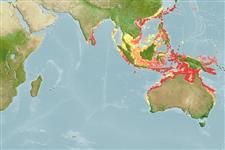
marinhas demersal; intervalo de profundidade 0 - 60 m (Ref. 106604). Subtropical; 30°N - 30°S, 30°E - 155°E (Ref. 114953)
Indo-West Pacific: Red Sea, Persian Gulf (Ref. 114953). Gulf of Thailand and the Philippines to Queensland, Australia. A similar and perhaps identical species occurs in the western Indian Ocean off Mozambique and in the Gulf of Aden and is probably sympatric with the true 'Rhynchobatus djiddensis' of the western Indian Ocean and the Red Sea. Distributional range probably wider than reported, but many nominal records of Rhynchobatus djiddensis from the western Pacific and southeastern Indian Ocean cannot be identified to species.
Comprimento na primeira maturidade / Tamanho / Peso / Idade
Maturidade: Lm ?, range 155 - ? cm
Max length : 124 cm TL macho/indeterminado; (Ref. 114953); 300.0 cm TL (female)
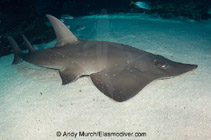
Inhabits inshore waters on the continental shelves (Ref. 9915). Demersal on soft bottoms and near coral reefs (Ref.58048). Female specimens may reach 300 cm in length in Thailand (Ref. 9915). Feeds on bottom crustaceans, mollusks (Ref. 9915) and bottom-dwelling fishes (Ref. 114953). Ovoviviparous (Ref. 50449). Caught commonly by demersal tangle net, and to a lesser extent by trawl and longline fisheries (Ref.58048). Marketed fresh; fins prized for the sharkfin trade (Ref. 9915).
Ciclo de vida e comportamento de acasalamento
Maturidade | Reprodução | Desova | Ovos | Fecundidade | Larvas
Exhibit ovoviparity (aplacental viviparity), with embryos feeding initially on yolk, then receiving additional nourishment from the mother by indirect absorption of uterine fluid enriched with mucus, fat or protein through specialised structures (Ref. 50449).
Compagno, L.J.V. and P.R. Last, 1999. Rhinidae (=Rhynchobatidae). Wedgefishes. p. 1418-1422. In K.E. Carpenter and V. Niem (eds.) FAO identification guide for fishery purposes. The Living Marine Resources of the Western Central Pacific. FAO, Rome. (Ref. 9915)
Categoria na Lista Vermelha da IUCN (Ref. 130435: Version 2025-2 (Global))
Ameaça para o homem
Harmless
Utilização humana
Pescarias: espécies comerciais
Ferramentas
Relatórios especiais
Descarregue XML
Fontes da internet
Estimativas baseadas em modelos
Temperatura preferida (Ref.
123201): 23 - 28.4, mean 27.3 °C (based on 802 cells).
Índice de diversidade filogenética (Ref.
82804): PD
50 = 0.5024 [Uniqueness, from 0.5 = low to 2.0 = high].
Bayesian length-weight: a=0.00372 (0.00166 - 0.00830), b=3.11 (2.91 - 3.31), in cm total length, based on LWR estimates for this (Sub)family-body shape (Ref.
93245).
Nível Trófico (Ref.
69278): 3.5 ±0.50 se; based on food items.
Resiliência (Ref.
120179): Baixo, tempo mínimo de duplicação da população 4,5 - 14 anos (Fec assumed to be <100).
Vulnerabilidade da pesca (Ref.
59153): Very high vulnerability (90 of 100).
🛈
Nutrientes (Ref.
124155): Calcium = 24 [4, 109] mg/100g; Iron = 0.722 [0.186, 2.061] mg/100g; Protein = 19.3 [17.2, 21.3] %; Omega3 = 0.199 [0.088, 0.435] g/100g; Selenium = 23.8 [6.9, 67.8] μg/100g; VitaminA = 6.67 [2.30, 18.89] μg/100g; Zinc = 0.577 [0.286, 1.044] mg/100g (wet weight);