Élasmobranches (requins et raies) (sharks and rays) >
Rhinopristiformes (Shovelnose rays) >
Pristidae (Sawfishes)
Etymology: Pristis: Greek, pristis = saw (Ref. 45335).
More on author: Garman.
Environnement : milieu / zone climatique / profondeur / gamme de distribution
Écologie
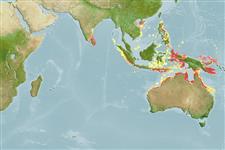
marin; saumâtre démersal; profondeur 1 - 20 m (Ref. 116378). Tropical; 20°N - 25°S, 46°E - 155°E (Ref. 114953)
Indo-West Pacific: tropical Australia, possibly more widely distributed. A nominal record from the Canary Islands may not be this species, but the sketchily known Pristis pristis from the eastern Atlantic is similar and needs comparison to determine if the two species are distinct (Ref. 009859). India (Bay of Bengal), Indonesia to eastern Australia, isolatted record from Réunion (Ref. 114953).
Taille / Poids / Âge
Maturité: Lm ? range ? - ? cm
Max length : 318 cm TL mâle / non sexé; (Ref. 116378); âge max. reporté: 34 années (Ref. 116378)
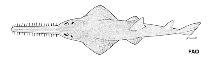
Greenish brown, rarely yellowish; white ventrally; fins paler. Body shark-like, pectoral fins distinct; head flattened, with a blade-like snout bearing 18-22 pairs of lateral teeth; blade broad, not tapering distally. Nostrils broad with large nasal flaps. Rostral teeth slender, with a groove along posterior margins; teeth reaching basal quarter of blade. Skin with denticles.
Body shape (shape guide): elongated.
Demersal in shallow coastal inshore habitats in mangrove swamps and embayments (Ref. 114953), intertidal species found in estuaries and on tidal mudflats (Ref. 9859). Ascends brackish areas of rivers (Ref. 9859). Ovoviviparous (Ref. 50449). Pupping thought to occur during the tropical wet season (November to March in Australia (Ref. 114953). Biology little known (Ref. 9859). Males mature at approximately 260 cm TL, females possibly slightly larger; born at 65 cm TL (Ref. 114953). Flesh may be good to eat (Ref. 6871).
Cycle de vie et comportement reproducteur
Maturité | Reproduction | Frai | Œufs | Fécondité | Larves
Ovoviviparous, embryos feed solely on yolk (Ref. 50449).
Compagno, L.J.V. and P.R. Last, 1999. Pristidae. Sawfishes. p. 1410-1417. In K.E. Carpenter and V. Niem (eds.) FAO identification guide for fishery purposes. The Living Marine Resources of the Western Central Pacific Vol. 3. FAO, Rome. (Ref. 9859)
Statut dans la liste rouge de l'IUCN (Ref. 130435: Version 2025-2 (Global))
Menace pour l'homme
Harmless
Utilisations par l'homme
Outils
Articles particuliers
Télécharger en XML
Sources Internet
Estimations basées sur des modèles
Indice de diversité phylogénétique (Réf.
82804): PD
50 = 0.5234 [Uniqueness, from 0.5 = low to 2.0 = high].
Bayesian length-weight: a=0.00501 (0.00199 - 0.01264), b=3.05 (2.82 - 3.28), in cm total length, based on LWR estimates for this (Sub)family-body shape (Ref.
93245).
Niveau trophique (Réf.
69278): 3.8 ±0.6 se; based on size and trophs of closest relatives
Résilience (Réf.
120179): Faible, temps minimum de doublement de population : 4,5 à 14 années (Fec assumed to be <100).
Vulnérabilité de la pêche (Ref.
59153): Very high vulnerability (90 of 100).
🛈