Ambiente: milieu / zona climatica / distribuzione batimetrica / gamma di distribuzione
Ecologia
marino; acqua dolce; salmastro pelagico; anadromo (Ref. 138280). Tropical; 13°N - 13°S
Africa: lagoons and lower parts of rivers from Liberia to Angola (Ref. 188, 2244, 28136, 81269, 81631), also in Guinea-Bissau (Ref. 3033); however it seems to be absent in the area between Ghana and Niger River Delta (Ref. 2244, 28136), except for Lake Nokoué (Ref. 81269). This species was not observed far upstream rivers (Ref. 2244), although it has been found recently in Léfini River, part of Middle Congo River basin (Ref. 88782). The type locality of the syntypes of the nominal species Pellonula stanleyana, 'Stanley Falls' (Ref. 2263), seems to be an erroneous locality (Ref. 188), and should be 'Cette Cama [= Sette Cama]' in Gabon (Ref. 2244).
Dimensione / Peso / Età
Maturità: Lm ? range ? - ? cm
Max length : 12.0 cm SL maschio/sesso non determinato; (Ref. 188)
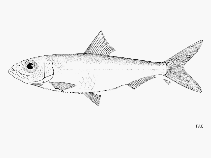
Spine dorsali (totale) : 0; Raggi dorsali molli (totale) : 15 - 19; Spine anali: 0; Raggi anali molli: 16 - 21; Vertebre: 42 - 43. Diagnosis: Body moderate or fairly deep, its depth 23-30% of standard length; 1 or more scutes beginning in front of base of first pectoral finray, with 11-16 pre-pelvic and 8-11 post-pelvic scutes, and a total of 20-25 scutes, first pre-pelvic scute always longer and better developed than following scutes lacking ascending arms; lower jaw slightly projecting, teeth at symphysis large in large specimens; pre-maxilla teeth well-developed, fairly straight and outward pointing, an indented toothless gap at centre of jaw; lower gillrakers 24-37, equal to or longer than corresponding gill filaments; silver stripe along flank (Ref. 188, 2244, 81269, 81631). It resembles Pellonula leonensis, which has small and inward-curving teeth and no pre-pectoral scutes (Ref. 188, 81269, 81631). The absence of large canine teeth in the upper jaw distinguishes it from Odaxothrissa (Ref. 188).
Body shape (shape guide): fusiform / normal; Cross section: compressed.
Adults are found in rivers and streams (Ref. 188). They form large schools in lower courses of rivers (Ref. 2244, 43836), and are very abundant in brackish water habitat (Ref. 86940).
Ciclo vitale e comportamento di accoppiamento
Maturità | Riproduzione | Deposizione | Uova | Fecondità | Larve
Gourène, G. and G.G. Teugels, 1991. Révision du genre Pellonula des eaux douces africaines (Pisces: Clupeidae). Ichthyol. Explor. Freshwat. 2(3):213-225. (Ref. 2244)
Stato della Lista Rossa IUCN (Ref. 130435: Version 2025-2 (Global))
Minaccia per l'uomo
Harmless
Usi umani
Pesca: pesca di sussistenza
Strumenti
Rapporti speciali
Scarica XML
Fonti Internet
Stime basate su modelli
Indice di diversità filogenetica (Fonte Biblio.
82804): PD
50 = 0.7500 [Uniqueness, from 0.5 = low to 2.0 = high].
Bayesian length-weight: a=0.00871 (0.00414 - 0.01834), b=3.06 (2.89 - 3.23), in cm total length, based on LWR estimates for this (Sub)family-body shape (Ref.
93245).
Livello trofico (Fonte Biblio.
69278): 3.1 ±0.3 se; based on size and trophs of closest relatives
Resilienza (Fonte Biblio.
120179): Medio, tempo minimo di raddoppiamento della popolazione 1.4 - 4.4 anni (Fec < 1,000).
Vulnerabilità della pesca (Ref.
59153): Low vulnerability (10 of 100).
🛈