>
Pleuronectiformes (Flatfishes) >
Bothidae (Lefteye flounders)
Etymology: Crossorhombus: Greek krossoi = tassel + Greek, rhombos = paralelogram (Ref. 45335).
More on authors: Hensley & Randall.
Môi trường: môi trường / vùng khí hậu / Mức độ sâu / phạm vi phân phối
Sinh thái học
biển gần đáy; mức độ sâu ? - 8 m (Ref. 9824). Temperate
Northwest Pacific: Taiwan. Southwest Pacific: Lord Howe Island. Possibly occurring in the Western Central Pacific.
Bộ gần gũi / Khối lượng (Trọng lượng) / Tuổi
Chín muồi sinh dục: Lm ? range ? - ? cm
Max length : 13.0 cm TL con đực/không giới tính; (Ref. 9824)
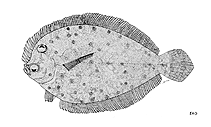
Các vây lưng mềm (tổng cộng) : 85 - 88; Tia mềm vây hậu môn: 64 - 69. Head and body on eyed side tan to grey with many small dark specks and spots. A series of dark spots very close to dorsal and ventral edges of body. About 4 or 5 spots along straight section of lateral line. Dorsal, anal, and caudal fin light coloured with small dark specks. Flaps on eyes of males with dark spots. Blind side of females tan to whitish. Males with distinct bluish black V-shaped mark on blind side. Ventral arm of "V" wider than dorsal arm. Body ovoid, its depth about 1.7 times SL. Head small, snout shorter than eye, profile steep anterior to interorbital area. Head length 3.9 to 4.2 times SL. Interorbital region broad and concave, probably wider in males than females. Males with a rostral spine and several small orbital spines. Both eyes on left side of head, front margin of upper eye over middle of lower eye. Flaps on posterior areas of eyes in males. Mouth small, reaching to below anterior margin of lower eye, length of upper jaw 3.5 to 4.1 times in head length. Teeth of upper jaw biserial, teeth of outer row more widely spaced than teeth of inner row. Teeth in lower jaw uniserial. Gill rakers short. Scales on eyed side with long ctenii. Scales on blind side cycloid. Pectoral fin on eye side with 11 or 12 rays and on blind side with 9 or 10 rays (Ref 42535).
Body shape (shape guide): short and / or deep.
Lives on silty sand bottoms and feeds on bottom-living animals. Only known from specimens collected from divers. Sexually dimorphic characters possibly develop at about 6-7 cm SL.
Vòng đời và hành vi giao phối
Chín muồi sinh dục | Sự tái sinh sản | Đẻ trứng | Các trứng | Sự sinh sản | Ấu trùng
Hensley, D.A. and K. Amaoka, 2001. Bothidae. Lefteye flounders. p. 3799-3841. In K.E. Carpenter and V. Niem (eds.) FAO species identification guide for fishery purposes. The living marine resources of the Western Central Pacific. Vol. 6. Bony fishes part 4 (Labridae to Latimeriidae), estuarine crocodiles. FAO, Rome. (Ref. 9824)
Tình trạng Sách đỏ IUCN (Ref. 130435: Version 2025-2 (Global))
Mối đe dọa đối với con người
Harmless
Sử dụng của con người
Các nghề cá: không ích lợi (thú vị)
Các công cụ
Báo cáo đặc biệt
Tải xuống XML
Các nguồn internet
Ước tính dựa trên mô hình
Chỉ số đa dạng phát sinh loài (Tài liệu tham khảo
82804): PD
50 = 0.5312 [Uniqueness, from 0.5 = low to 2.0 = high].
Bayesian length-weight: a=0.00912 (0.00412 - 0.02018), b=3.05 (2.87 - 3.23), in cm total length, based on LWR estimates for this (Sub)family-body shape (Ref.
93245).
Mức dinh dưỡng (Tài liệu tham khảo
69278): 3.5 ±0.37 se; based on food items.
Thích nghi nhanh (Tài liệu tham khảo
120179): Trung bình, thời gian nhân đôi của chủng quần tối thiểu là 1.4 - 4.4 năm (Preliminary K or Fecundity.).
Sự dễ bị tổn thương của nghề đánh cá (Ref.
59153): Low vulnerability (10 of 100).
🛈