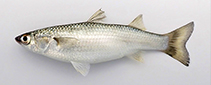
Classification / Noms
Noms communs | Synonymes | Catalog of Fishes(Genre, Espèce) | ITIS | CoL | WoRMS | Cloffa
Taxonomic Remarks
This species has morphological characters related to the second vertebra (Ref. 123404) that are diagnostic to the genus Planiliza.(Refs. 115045, 123265), Placed in Chelon in ECoF.
Environnement : milieu / zone climatique / profondeur / gamme de distribution
Écologie
marin; saumâtre pelagic-neritic. Subtropical
Northwest Pacific: Japan through the Ryukyus, Korea, China, Taiwan, to Vietnam (Ref. 137907). Might occur as a rare visitor to the northern extreme of the Western Central Pacific.
Taille / Poids / Âge
Maturité: Lm ? range ? - ? cm
Max length : 39.4 cm TL mâle / non sexé; (Ref. 121531); poids max. publié: 408.30 g (Ref. 121531)
Épines anales: 3; Rayons mous anaux: 8 - 9; Vertèbres: 24. This species is distinguished by the following characters: hind tip of maxilla exposed when mouth is closed; head relatively small and flattened dorsally, head length 22-28% of SL; adipose eyelid is developed anteriorly and posteriorly covering part of iris; mid-dorsal line is sharply keeled; second vertebra with a pair of long, spine or antenna like neural postzygapophyse; stomach gizzard-like, with five unbranched pyloric caeca; transverse scales 11-13 (mode 12) rows; scales in lateral series usually 36-40; pectoral-fin usually with 17 rays; pectoral-fin length, 14-18% of SL, not reaching to level of first dorsal fin; supraneurals 3, the first between second and third vertebrae, second between fourth and fifth vertebrae, and third between fifth and sixth vertebrae; first pterygiophore of spinous dorsal fin positions in between sixth and seventh vertebrae (Ref. 137907).
Body shape (shape guide): fusiform / normal; Cross section: compressed.
Occurs in coastal and estuarine waters near river mouths, occasionally visiting upstream tidally influenced zones (Ref. 137907). Oviparous, eggs are pelagic and non-adhesive (Ref. 205). Consumed locally in many places but likely not fished in commercial quantities (Ref. 137907).
Used as food fish in Japan.
Cycle de vie et comportement reproducteur
Maturité | Reproduction | Frai | Œufs | Fécondité | Larves
Hasan, M. E., A. Hasan, P. Béarez, K.-N. Shen, C.-W. Chang, T. T. V. Tran, D. Golani, A. Al-Saboonchi, P. J. A. Siddiqui and J.-D. Durand, 2022. Planiliza lauvergnii (Eydoux & Souleyet, 1850), a senior synonym of Planiliza affinis (Günther, 1861) with a re-evaluation of keeled back mullets (Mugiliformes: Mugilidae). Zootaxa 5194(4):497-518. (Ref. 137907)
Statut dans la liste rouge de l'IUCN (Ref. 130435: Version 2025-2 (Global))
Menace pour l'homme
Harmless
Utilisations par l'homme
Pêcheries: pêcheries vivrières
Outils
Articles particuliers
Télécharger en XML
Sources Internet
Estimations basées sur des modèles
Indice de diversité phylogénétique (Réf.
82804): PD
50 = 0.5001 [Uniqueness, from 0.5 = low to 2.0 = high].
Bayesian length-weight: a=0.01047 (0.00694 - 0.01581), b=2.93 (2.81 - 3.05), in cm total length, based on LWR estimates for this species & Genus-body shape (Ref.
93245).
Niveau trophique (Réf.
69278): 2.0 ±0.0 se; based on diet studies.
Generation time: 2.1 ( na - na) years. Estimated as median ln(3)/K based on 1
growth studies.
Résilience (Réf.
120179): Haut, temps minimum de doublement de population inférieur à 15 mois (Preliminary K or Fecundity.).
Vulnérabilité de la pêche (Ref.
59153): Low to moderate vulnerability (26 of 100).
🛈