>
Eupercaria/misc (Various families in series Eupercaria) >
Sciaenidae (Drums or croakers)
Eponymy: Rev Dr Christoph Samuel John (1747–1813) was a botanist and herpetologist and a medical missionary (1771–1813) at the Danish trading station of Tranquebar (now Tharangambadi), Tamil Nadu, not far from Madras (Chennai). [...] (Ref. 128868), visit book page.
More on author: Bleeker.
Ambiente: milieu / zona climatica / distribuzione batimetrica / gamma di distribuzione
Ecologia
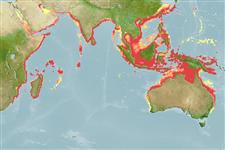
marino; acqua dolce; salmastro benthopelagico; distribuzione batimetrica 0 - 132 m (Ref. 57178). Tropical; 30°N - 36°S, 32°E - 155°E (Ref. 56999)
Indo-West Pacific: Persian Gulf eastward to southern China and Taiwan and northern and northeastern Australia and New Guinea.
Lunghezza alla prima maturità / Dimensione / Peso / Età
Maturità: Lm 15.9 range ? - ? cm
Max length : 34.8 cm TL maschio/sesso non determinato; (Ref. 55968); common length : 20.0 cm SL maschio/sesso non determinato; (Ref. 9772)
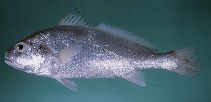
Spine dorsali (totale) : 10 - 12; Raggi dorsali molli (totale) : 27 - 32; Spine anali: 2; Raggi anali molli: 7 - 8. Snout rounded but not swollen or projecting; mouth large, oblique; upper jaw extending backward below posterior half of eye; no barbel on chin; teeth in narrow bands, well differentiated into large and small in both jaws, but none canine-like; gill rakers slender, about half length of gill filaments at angle of arch, 9 to 15 on lower limb. Second anal spine moderately long, 24 to 42 % of head length. Scales on head cycloid (smooth). Swim bladder hammer-shaped, the first pair of arborescent appendages entering head beyond transverse septum and sending a palmate branch to the front of pectoral arch. Sagitta (large earstone) with a tadpole-shaped impression, the head of which has its long axis lying obliquely to that of sagitta and the tail expanded and deepened as a hallow cone connected with the head by narrow groove.
Body shape (shape guide): fusiform / normal.
Inhabits shallow coastal waters, estuaries, and rivers. In India, matures at the size of 14 to 16 cm TL; attains an average size of 15.8 cm TL, 20.6 cm TL, and 24 cm TL, at the end of 1 year, 1.5 years and 2 years, respectively. Juveniles prefer crustaceans and as they grow , show piscivorous tendency (Ref. 9772). Marketed fresh and dried salted (Ref. 3490).
Ciclo vitale e comportamento di accoppiamento
Maturità | Riproduzione | Deposizione | Uova | Fecondità | Larve
Sasaki, K., 2001. Sciaenidae. Croakers (drums). p.3117-3174. In K.E. Carpenter and V.H. Niem (eds.) FAO species identification guide for fishery purposes. The living marine resources of the Western Central Pacific. Volume 5. Bony fishes part 3 (Menidae to Pomacentridae). Rome, FAO. pp. 2791-3380. (Ref. 9772)
Stato della Lista Rossa IUCN (Ref. 130435: Version 2025-2 (Global))
Minaccia per l'uomo
Harmless
Usi umani
Pesca: scarso interesse commerciale
Strumenti
Rapporti speciali
Scarica XML
Fonti Internet
Stime basate su modelli
Temperatura preferita (Fonte Biblio.
123201): 24.6 - 29.1, mean 28 °C (based on 2424 cells).
Indice di diversità filogenetica (Fonte Biblio.
82804): PD
50 = 0.5000 [Uniqueness, from 0.5 = low to 2.0 = high].
Bayesian length-weight: a=0.00490 (0.00324 - 0.00740), b=3.12 (3.00 - 3.24), in cm total length, based on LWR estimates for this species & Genus-body shape (Ref.
93245).
Livello trofico (Fonte Biblio.
69278): 3.7 ±0.4 se; based on diet studies.
Resilienza (Fonte Biblio.
120179): Alto, tempo minimo di raddoppiamento della popolazione meno di 15 mesi (K=0.5-0.8).
Vulnerabilità della pesca (Ref.
59153): Low vulnerability (22 of 100).
🛈